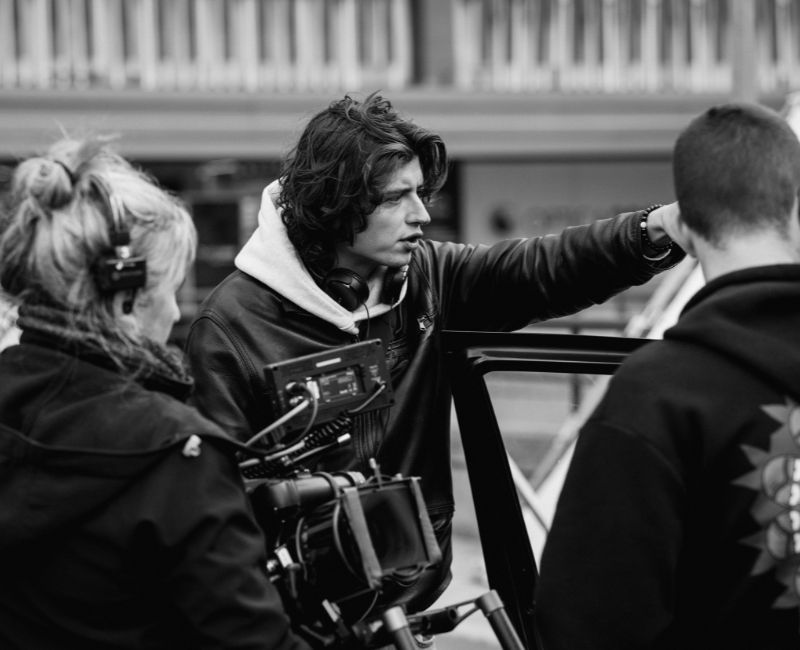
Since 2018, director Andrew De Zen has collaborated with artist Alaskan Tapes on five projects that lie somewhere between music videos and short films. These projects have steadily become more grand and ambitious, but throughout this growth, an emotional core has remained, with each work exploring delicate, complex feelings and relationships. There is a stillness to how the director tells stories that almost disguises the sometimes truly bombastic visuals that he shows us. His use of light, color, shapes and movement is absolutely gorgeous.
With a clear and deep understanding of sci-fi’s visual language, De Zen knows how to create striking, vivid imagery that isn’t just beautiful or mysterious for its own sake, but that connects to deeper layers of meaning and emotion. He explores these layers without feeling the need to explain them, and the form of music video/short film allows him to give us plenty of room for personal interpretation – there might be unanswered questions, but the stories don’t feel unfinished or incomplete.
Short film/music video ‘Holocene’, released last February, marks your fifth collaboration with Brady Kendall a.k.a. Alaskan Tapes. How did you two initially meet, and what made you decide to start working together?
Brady and I met years ago after I saw his initial music video and immediately got lost in his music. We connected quickly, sharing similar ideas and tastes.
Your collaboration already started off ambitious, with a series of three loosely connected videos, and I feel like each work since has gotten slightly more ambitious. Is this just a natural development, or do you have a clear desire to keep going bigger?
I think it’s an unfortunate case of me wanting to explore ideas in ways that challenge me further and further. It’s perhaps a bit problematic, but it has been a rewarding experience, definitely leading to some adventures along the way. Some part of it must be a natural process, following your own desires and the things you want to delve deeper in with the work. There is a big part of me that wants to do some crazy big things.
In regards to going bigger: ‘Holocene’ and ‘Of Woods and Seas’ rely heavily on VFX. What impact does working with VFX have on a project? Which things become easier, and which become more difficult?
The VFX element isn’t too complicated, especially these days, but I find it’s the format of it that makes it challenging. These are small, short form projects that lack strong sturdy foundations to keep the whole thing supported when you expand and expand and expand. The ambition is wonderful and I love chasing after these larger conceptual ideas, images that need VFX enhancement, but yes, it makes the whole project start to wobble. I’ve seen it go both ways, succeed or fail, based on how sturdy the production actually is, and if you have the support systems you need in place to allow all the ambition to land on its feet.
The impact highly depends. If you’re not willing to take the brunt of extra responsibility, all the VFX research and prep work, it will probably fail. Production isn’t too affected I find. The quality of the relationships between your technicians, VFX leads, and producers is hugely important. The difficulty for me personally is keeping the train from derailing through communication in post production, through emails and emails. I’ve learned you need to really overcommunicate, get people communicating, and ensure meetings are using everyone’s time valuably. I suppose it’s the management part of it all that becomes more loaded.
‘Holocene’ and ‘Of Woods and Seas’ both deal with parenthood. Is this a coincidence, or has this theme been more resonant to you lately?
Ha. Not a coincidence at all. Personally, the stories I am really interested in are parent-child stories. There are personal reasons for that – goes without saying. It’s less an interest I guess, and more what I can speak to honestly. A lot of my future films and scripts have this relationship between a child and their parent.
Do you consider your work with Alaskan Tapes to be music videos or short films? How important or meaningful is that distinction to you?
I’m a super easy-going person – until I’m directing and freaking out and getting all intense – when it comes to these sorts of things. I barely know the distinction myself. That’s what makes these projects so fun. I don’t particularly care which one it is, but I’d say it’s definitely some kind of hybrid between the two.
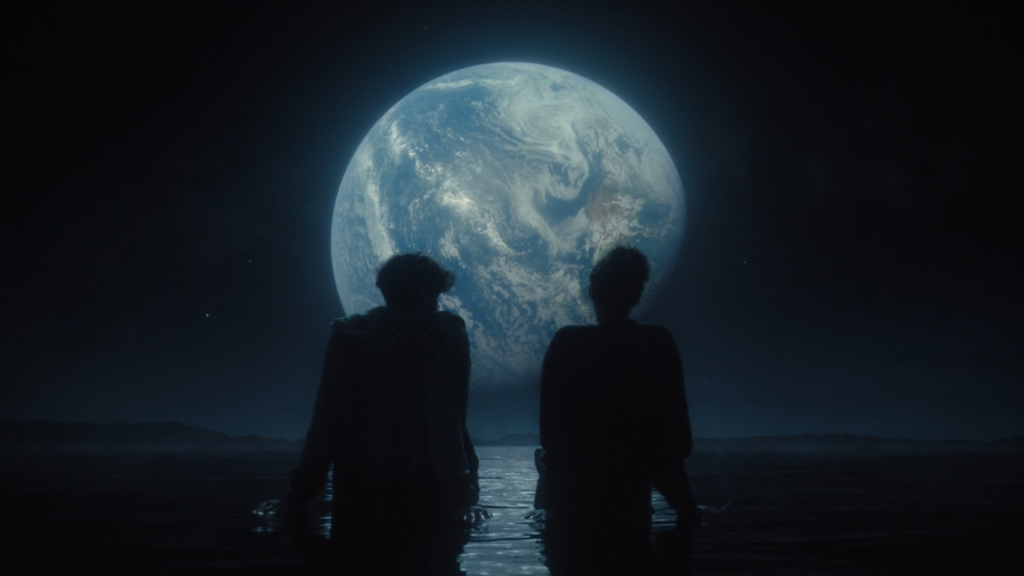
About ‘Holocene’, you’ve said “There are a few images in this film that have been burnt into my brain for years now and it’s a desperate attempt to bring those to life”. I feel like I have some idea of which images these might be, but I was hoping you would tell me. What was the process like of creating a narrative from these images?
Yeah. The first image was the kids in the water framed against the Earth. That was the first seed of this project, and that’s normally how it all starts for me. I’m super visual. And emotionally sensitive haha. So there’s normally a strong image, and a visceral feeling that sparks the beginning of “is this a film?” For ‘Holocene’ in particular, it’s asking myself who these people are, what’s going on, what’s the conflict, what’s the relationship, what are things I would like to see and feel, etc. I go from there, towing the line between rational and emotional logic.
Are there any other images burnt into your brain, that you’re still looking to bring to life?
Many haha. Too many. There’s a whole soup of them swimming around my mind. With a handful that I’m hoping to develop and shoot this year. One of a joyride gone wrong, and the other of a young girl running away from her mother on a bike with her invisible best friend, in a world with creatures that are walking mountains and moving islands.
Your style is often described as poetic, and there’s a strong focus on implicit, impressionistic storytelling. How do you find the right balance between conveying the message of a story and not making things too literal?
It’s a tricky balance, and feels highly dependent on who is watching too. That’s an ongoing process, and as much as I like the whole visual poetry of things, I’m also a bit tired of it. I feel like there’s a whole side that I’m itching to explore of myself through film and storytelling that is a bit more visceral, twisted, and kinda relishing in some dark material. So that’ll be interesting.
To me, a director only has to worry about one thing: clarity. But that becomes very subjective, and the goal of what you’re trying to clearly communicate isn’t always a rational idea that can be easily said through words. You have to clearly define a sequence of ideas shot by shot, build sequences that follow some kind of logic, but if you go through Tarkovsky’s The Mirror or a Mulholland Drive or an End of Evangelion, what makes those films so captivating is the fact that you can’t easily decipher what we’re supposed to take away from them. But the person leading the idea, direction, intention has loaded it with whatever clear emotional clarity they want to say. A painful amount of themselves is loaded and pressed into it. So that you receive… something.
I find that if you don’t go through that intensely personal process to load the work with yourself imprinted on it, it’s just false. Your “message” is bullshit. And you’re wanting to make some pretentious piece of a thing.
You’ve moved to Paris relatively recently. How have you been enjoying this new environment, and what impact has it had on your work?
Paris has been amazing. Moving to Europe has always been a dream of mine. As a Canadian in film you’re always thinking ‘okay, when do I make the move to LA or NYC?’ And that just didn’t feel right. I had moved to Barcelona first about a year and then found myself in Paris and haven’t looked back. It’s a wonderful place. The environment of it, the love of cinema, art, fashion – it’s incredibly stimulating and has been a great spark in my life. It’s less the city itself, but we all need to change and grow. I had been in Toronto a little too long and let myself get stuck in the place, that environment. So it’s been incredibly rewarding to find something new. New language. New people. It has completely changed my life.
In a 2023 interview with Director’s Notes, you talked about wanting to do a cinematic trailer. Have you made any progress in this desire? What do you love so much about these trailers?
Great eye! I am a huge huge nerd to my core. And an even bigger gamer. So being able to do cinematic trailers is still a dream. I think I’m chipping away at it. When the time is right. I’ve been pushing my work to land in more VFX and that has slowly been working out. As with anything, a bit of patience doesn’t hurt. It’s just that… I can be wildly impatient with these things haha. Fingers crossed.
More Andrew De Zen:
Short film Let This Feeling Go
Interview about ‘Holocene’
Interview about ‘Of Woods and Seas’
Interviews with Director’s Notes
Website