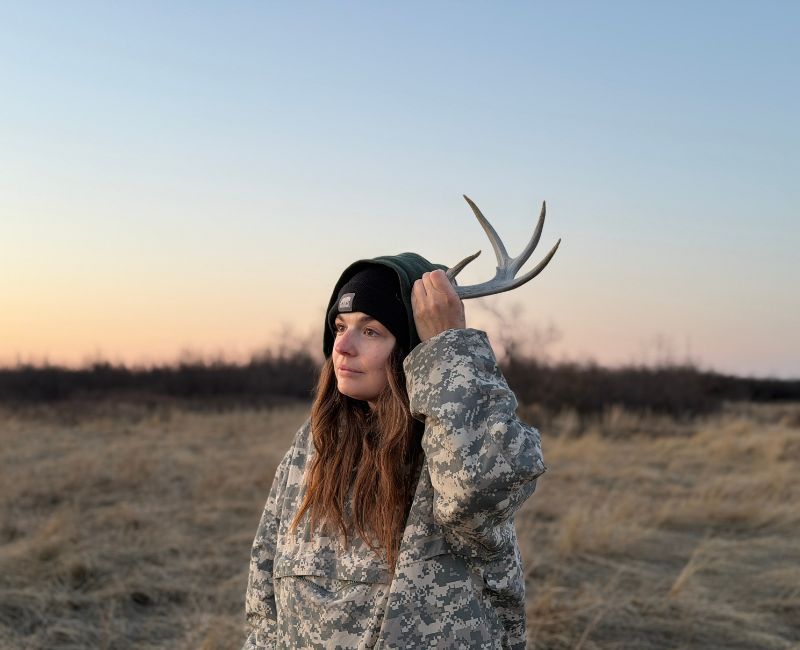
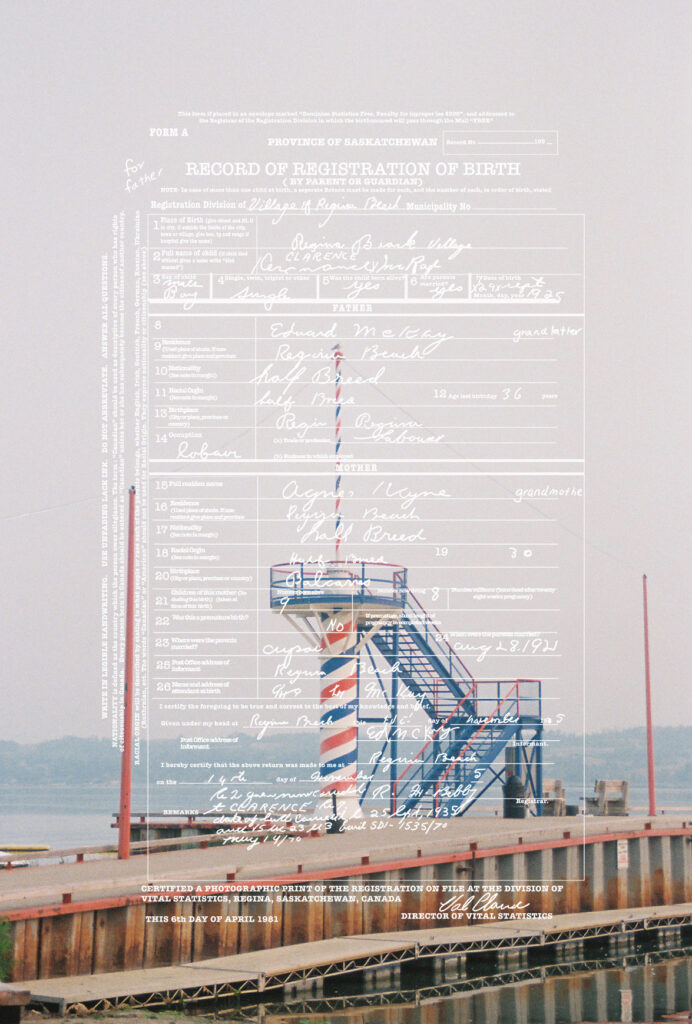
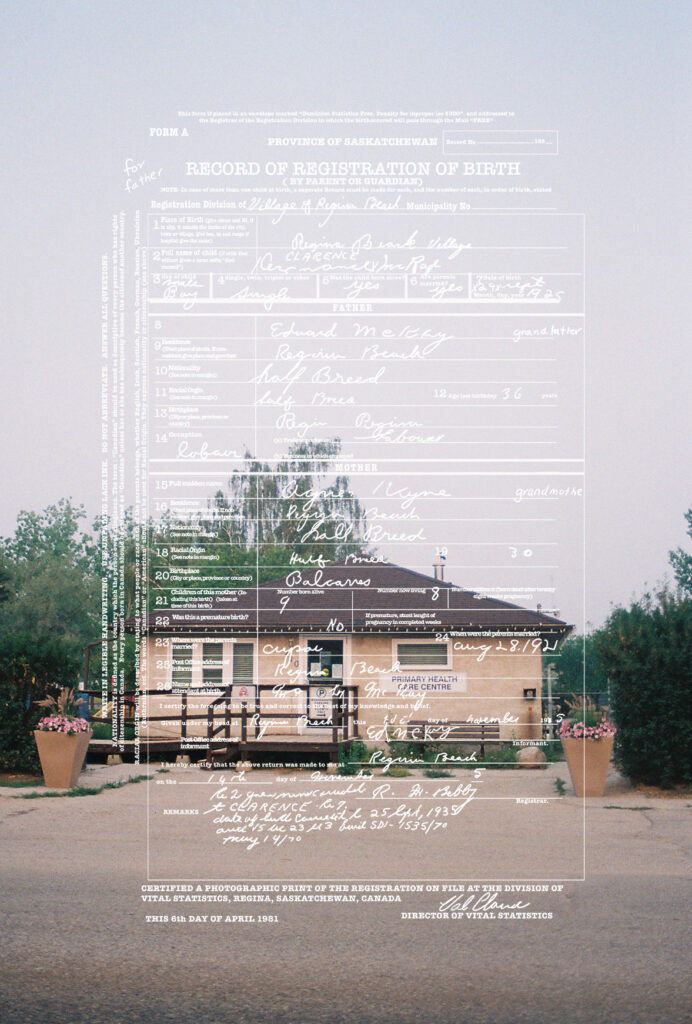
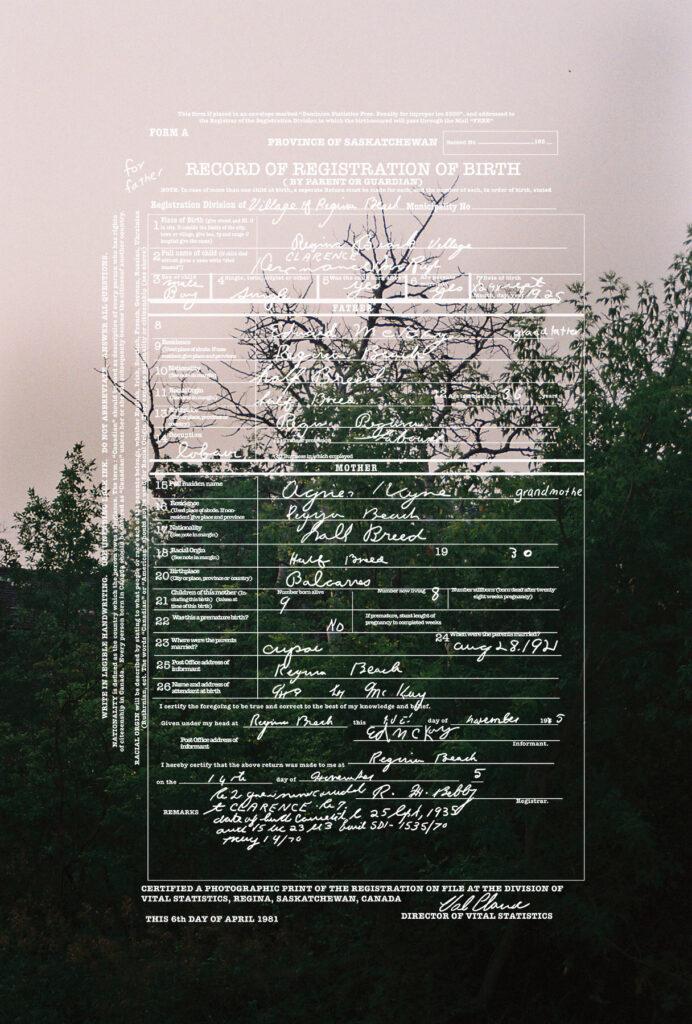
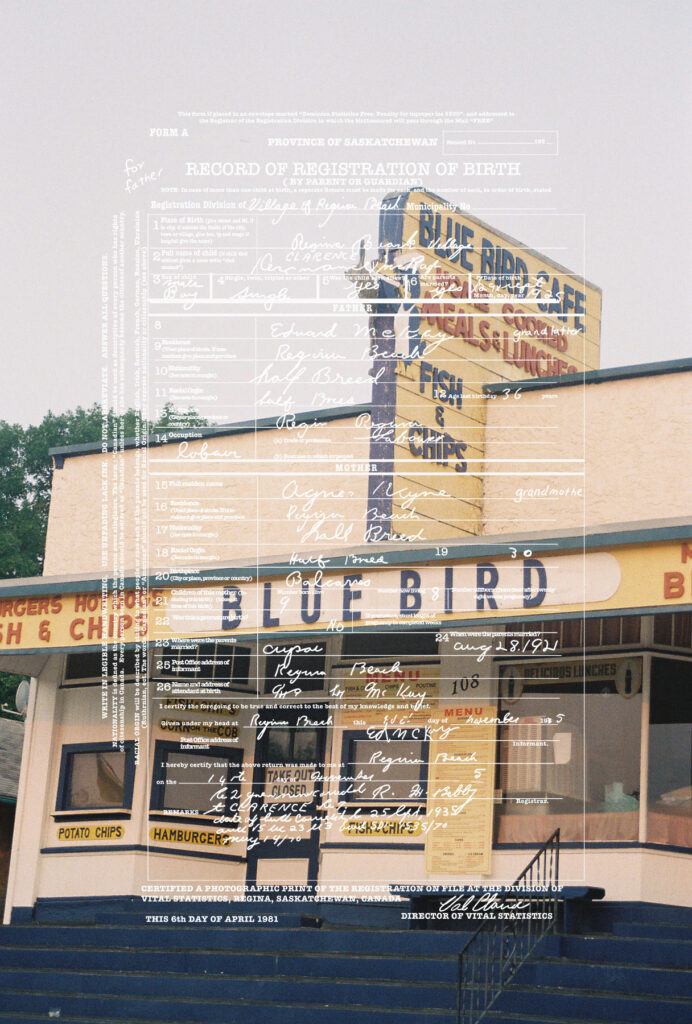
Nahanni McKay is a visual artist whose work deals with our relationship to nature – particularly focusing on the impact of tourism on the landscape around her hometown of Banff – and her Indigenous identity as a member of Otipemisiwak (Métis Nation of Alberta). Her project ‘Halfbreed’ is a powerful exploration of this identity and her family’s history, centered around the term “Half Breed” used in her grandfather’s birth certificate. This certificate is traced onto photographs taken in his birthplace, Regina Beach in Saskatchewan. The project speaks to the destructive legacy of colonialism and the ways in which identity can be created or rejected. This thread of colonialism can be recognized throughout McKay’s work; a looming presence as she discusses the commodification of nature and the appropriation of Indigenous culture.
As I was discovering Nahanni McKay’s work, with its nature and landscape photography, explorations of identity and critiques of tourism, I kept thinking of permanence: how a landscape and its wildlife, or a culture and the identity it shapes, can seem so eternal, but can also easily become altered, damaged or entirely destroyed by (neo)colonial practices. Same as it ever was.
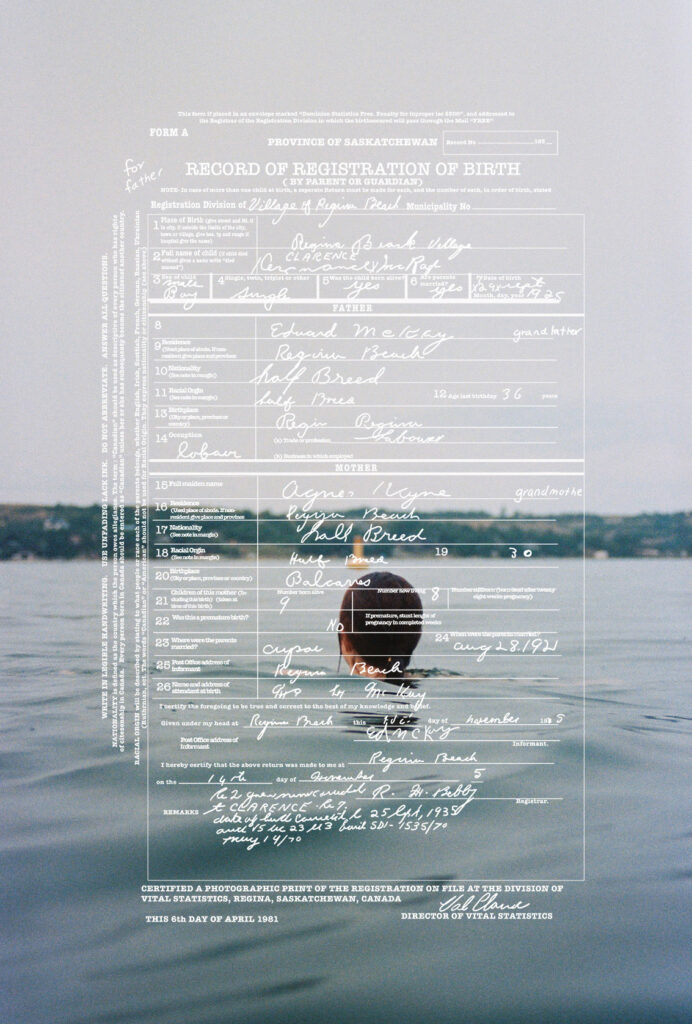
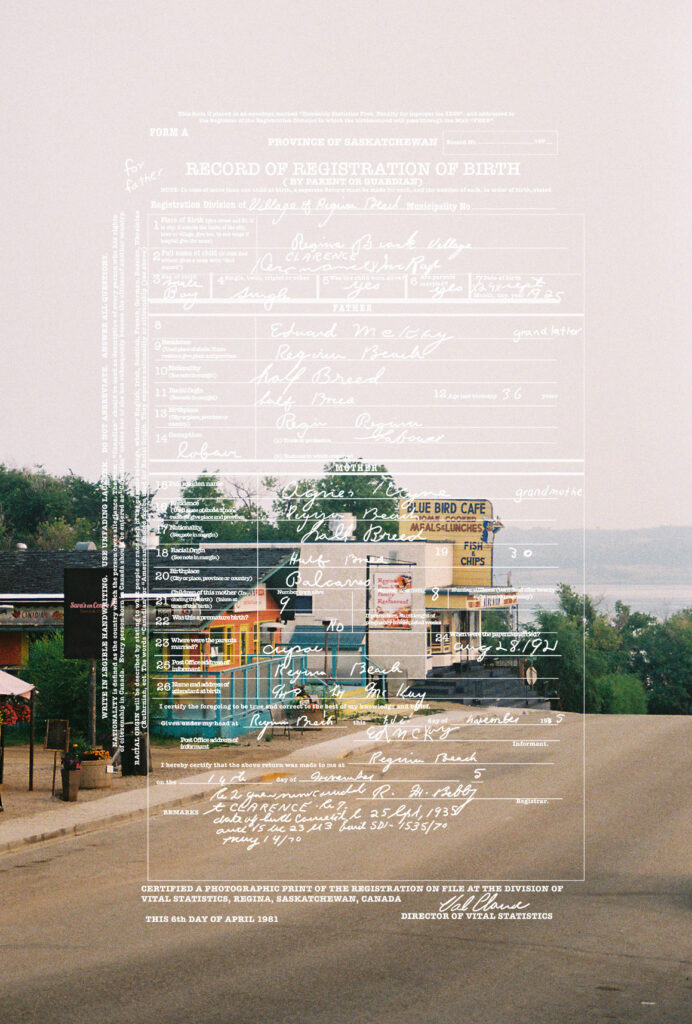
I thought ‘Halfbreed’ was very moving and beautiful, and I wanted to delve into the process behind this work. First of all, I was curious about the choice to incorporate the birth certificate into the images. What inspired this decision? Did you also experiment with other ways of combining the certificate with the photographs?
As a photographer I am always trying to experiment with new ways of photography. I once carried a bucket of water from the Bow River to my dark room so I could say the water was part of the photograph. I experimented with the birth certificate by collaging it over my photographs of Banff, but it didn’t feel right when it said “Regina Beach”.
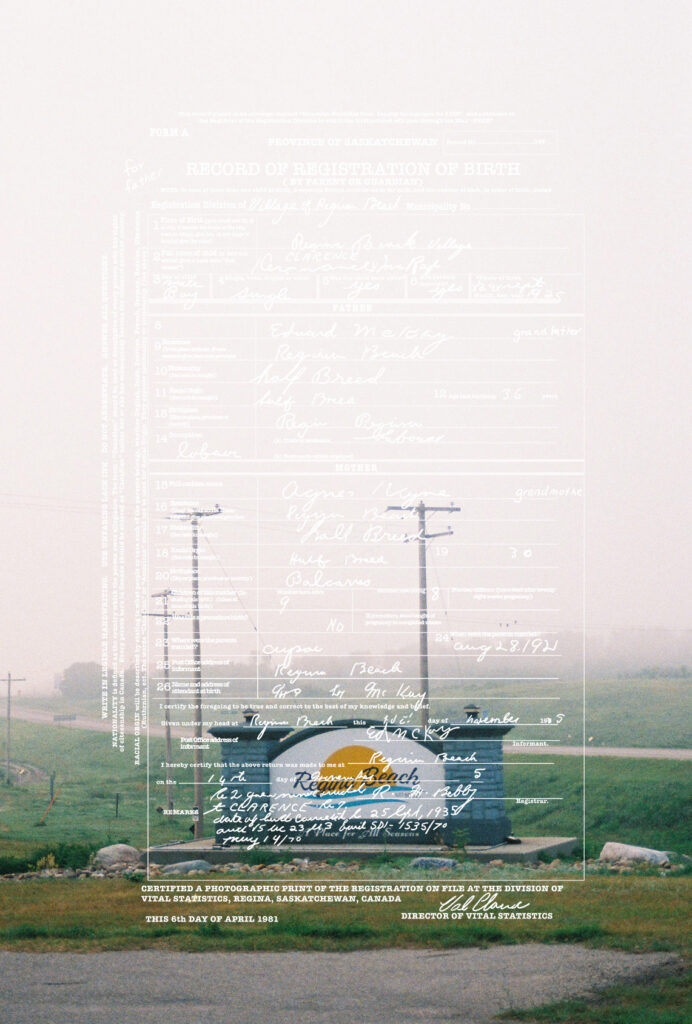
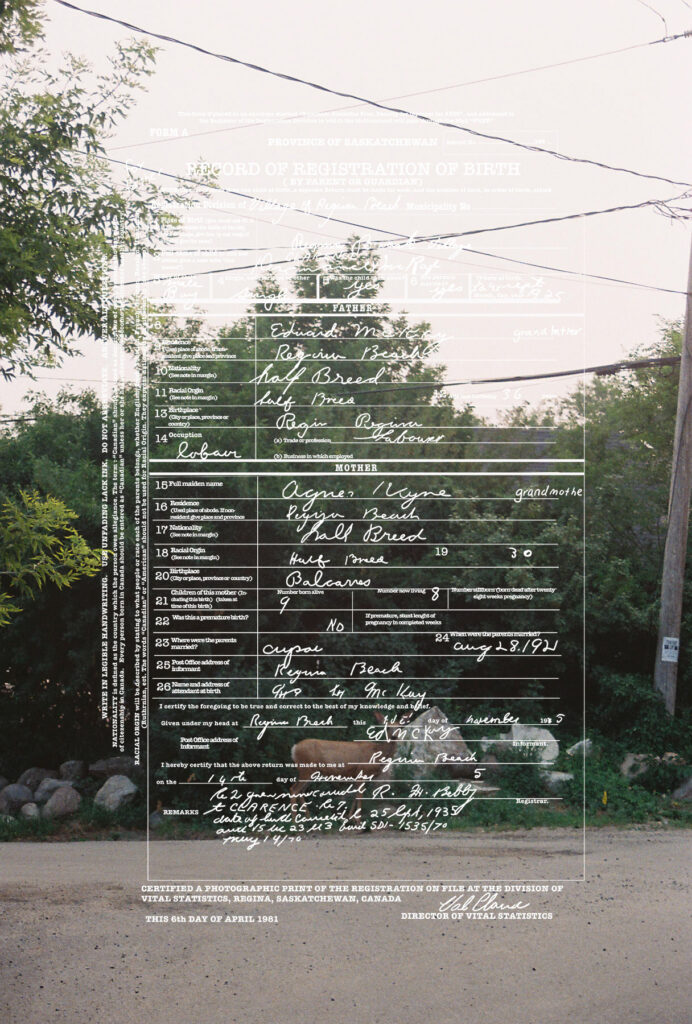
When picking the photographs to be used in this project, what were you looking for? Why did you select these specific images?
I knew I had to make the trip to Regina Beach, Saskatchewan where my grandfather grew up. In the summer of 2024 my sisters and I went to the Métis festival in Batoche, Saskatchewan. I cried, not just out of emotion but because of the heat as well. I also felt like I was going to have a panic attack over how flat it was, you could see forever out there.
I convinced my sisters to take a side quest down to Regina Beach. It wasn’t hard to convince them since I told them I would pay for the air conditioned hotel room. There, we arrived at a bustling downtown where kids were running in swim suits, people were lining up for ice cream and visitors were taking photos by the lake. We always joke that our family loves the resort towns no matter the province. The morning after an evening of swimming and having fish & chips, I got up early for sunrise, my favorite time of day to take photos. I walked down every street and just looked over the lake. It was quite peaceful and the photos came out exactly how I intended: calm.
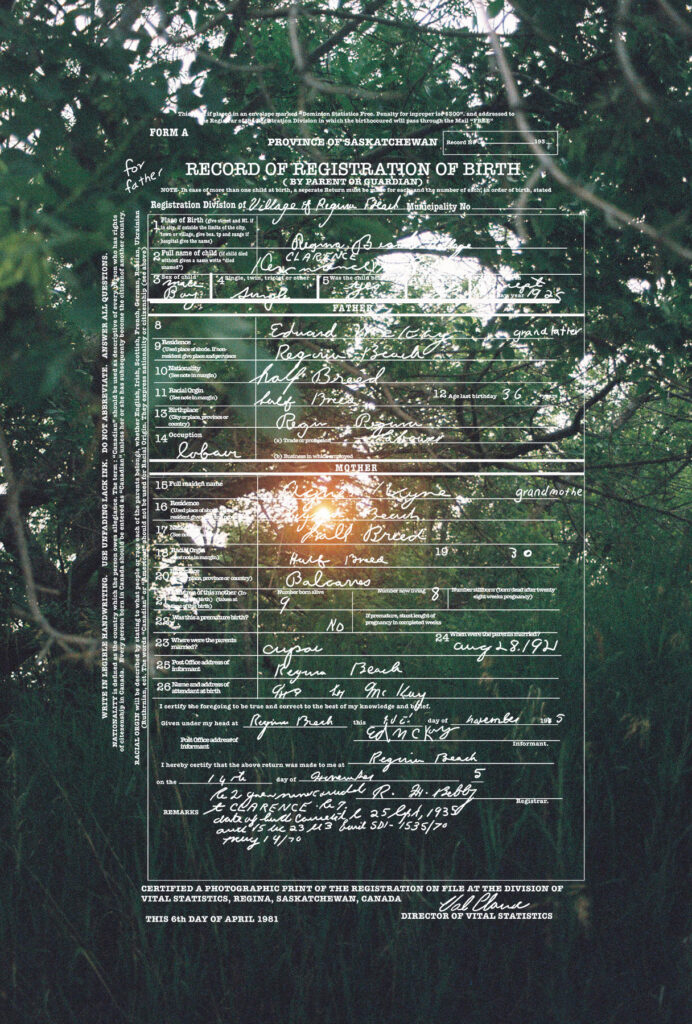
The term ‘half breed’ carries such negative, racist meanings. How did it feel to see it being used to label your family, and therefore you as well? And what made you decide to use it as the title for this project?
The only way I can describe it from a universal perspective is, do you remember in Harry Potter when Draco called Hermoine a mudblood? It feels like that. That there is a term that people can use against you that makes you feel like you don’t belong. That you walk in two worlds where you are not accepted, well not fully anyway.
The term ‘half breed’ is deeply loaded. It’s a word that was historically used to reduce Métis people to question our place. Encountering this term in an official document made me think about how language is carried across generations. I chose to use Halfbreed as the title of the project because I wanted to reclaim the term, expose it. I’m trying to shift the power dynamic around it and how colonial language shapes Indigenous identity even today.
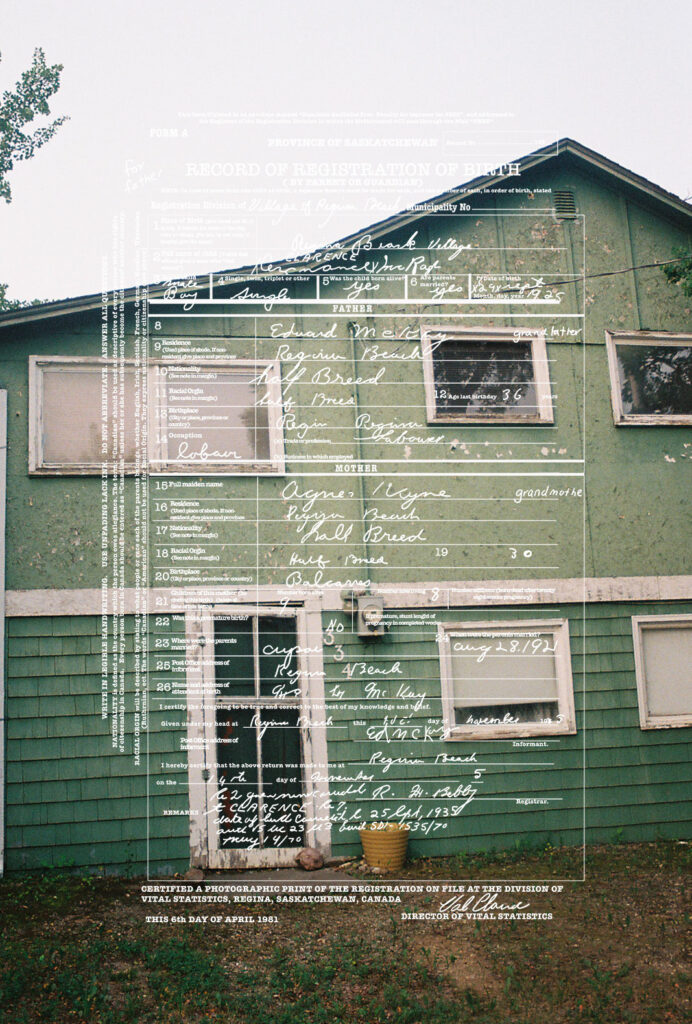
Obviously, this work is deeply connected to your family’s history. What was it like to use your family in your art like this? How did it affect your relationship with your ancestry and your Indigenous identity?
My grandfather and my dad had a complicated relationship. But then again, who doesn’t have a complicated relationship with their dad? My Métis family has been deeply impacted by generational trauma which made it hard to connect to family and ask questions. But even so, my dad always made sure we knew our roots. These traditions didn’t involve a trip to Saskatchewan, it involved being on the land. He is a mountain guide so it was important for us to be in the backcountry as much as possible. I feel most Indigenous in the mountains, if that makes sense. My research into this work had me take more of a deeper look into the history of Métis and where we came from historically. This project strengthened my relationship to my Indigenous identity by allowing myself to be educated in the deep colonial history of being Métis.
You’ve mentioned Martin Parr as one of the biggest influences on your work. I was wondering what you love about his work, and how you translate his anthropological style to your own work, which is generally more focused on nature photography.
I love Martin Parr. It is funny when people ask who my biggest inspiration is as a photographer – I don’t think they expected an old white man from the UK. But I was attracted to the way he documented tourism in his work Small World from 2007. It made me curious about how he got those photographs of tourists doing the strangest, most mundane stuff. Because it makes me want to photograph Banff that way, next time I see someone try to pet an elk I will be there with my camera… right after I call dispatch of course.
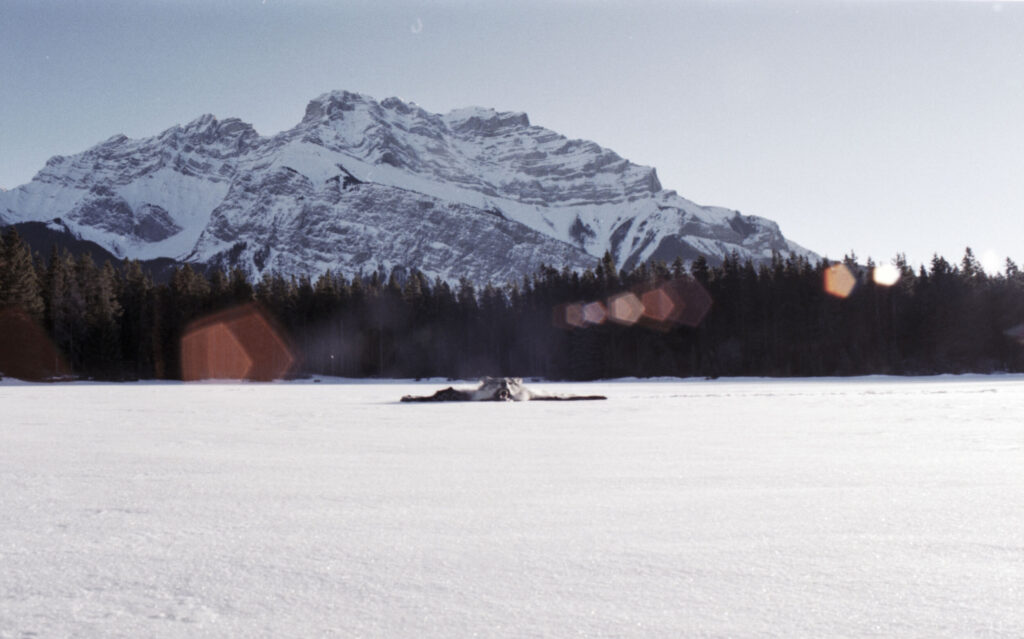
On your website, you talk about the claim that “landscapes are boring” and your own relationship to landscape photography. As you’ve developed as an artist, has your relationship with landscape photography changed?
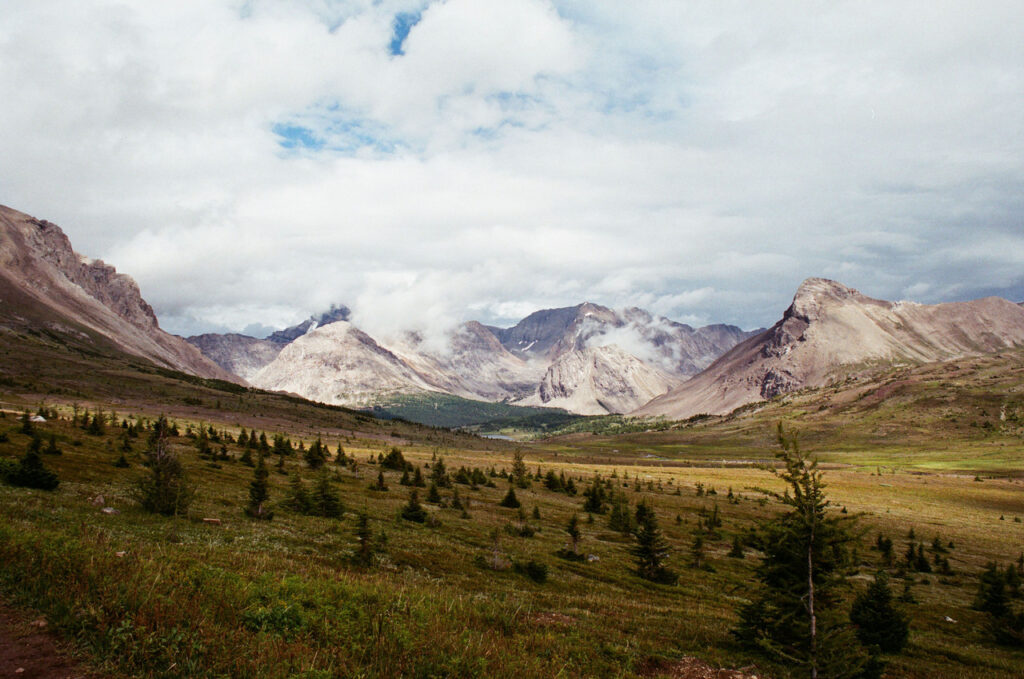
That work, ‘Landscapes are Boring’, came from someone in my undergrad photography class calling my work boring. Like many artists in Banff, I am inspired by the mountains. During my time at Emily Carr, I was constantly bringing photographs of Banff into class that I had taken over summer break. Some professors completely dismissed me as an artist because of that work, but a few recognized that I had a genuine connection to this place and encouraged me to explore it more deeply and in different ways. My relationship to land has definitely changed, it’s no longer exploitive, but appreciative. I take less photographs and spend more time outside, listening to the river, air and animals… There’s nothing out there, maybe that’s why it is boring?
Does it ever feel paradoxical to explore your connection with nature through the technology of photography?
A little, I always talk about my colonial art practice with my Indigenous lens (no pun intended). Where you have a technological invention that communicates my love for the land, it’s playing with two worlds, just like being Métis.
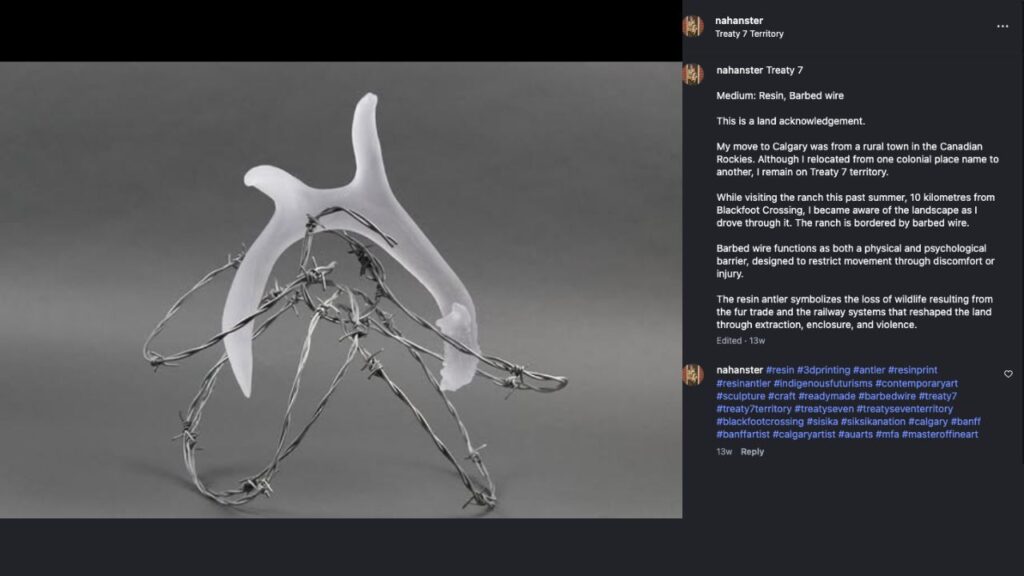
In an artist statement from 2021, you talk about wanting to push your work in different directions and not limiting yourself to only photography. What, to you, are the limits of photography, and what do these different directions allow you to do?
I want to go beyond photography and push myself into craft. Photography is still my favourite medium but in a digital world I crave something real. That’s why I am trying to perfect my beadwork, to spend more time in the studio off a computer, and feel the material with my hands.
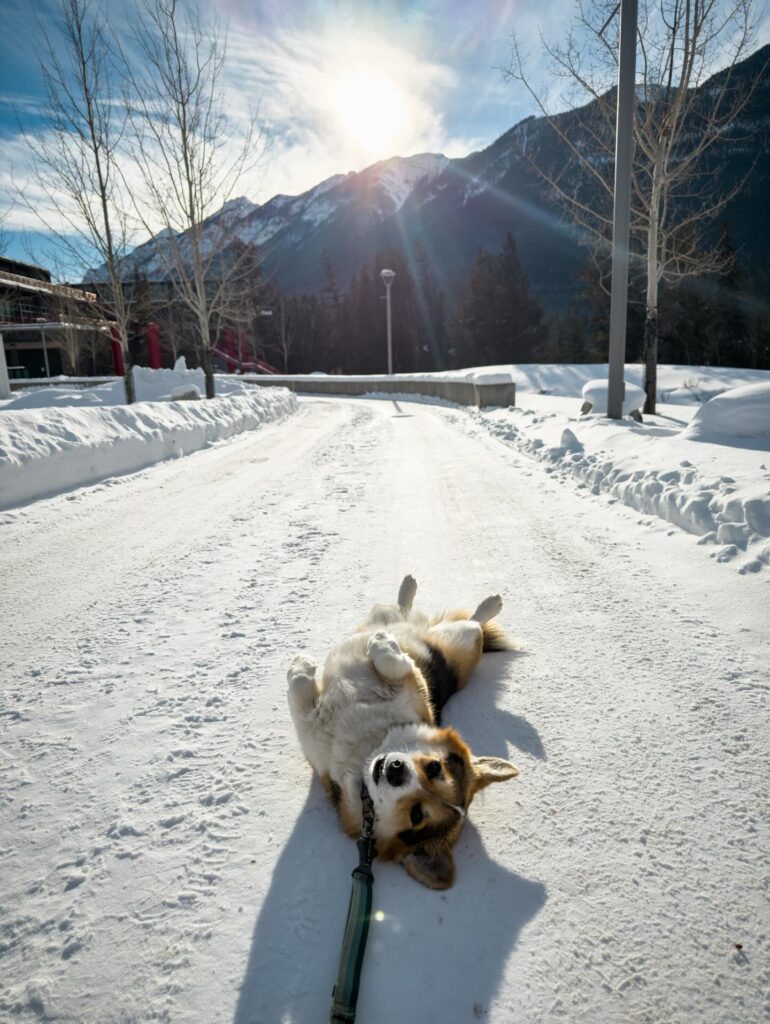
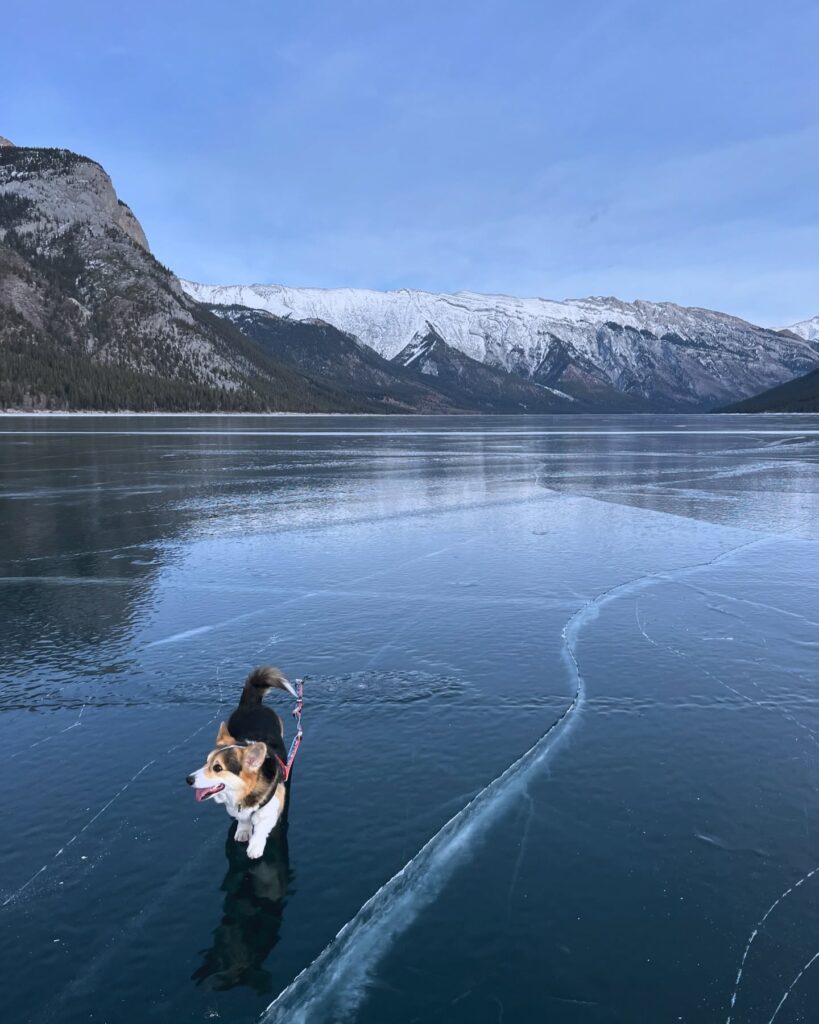
On a completely different note, you have an Instagram page, @banffcorgi, dedicated to your corgi Lupo. Could you tell a bit about Lupo? How has it been to (re)discover the area you grew up in with your dog?
Lupo is my sweet and sassy corgi. I got him in 2022 with an ex and over time he really became my dog. He’s been with me through some of the highest and lowest moments of my life, and during periods when I felt isolated, I never truly felt alone because I had him beside me. There’s something incredibly grounding about that kind of bond.
He’s also a true mountain dog. People often imagine you need an alpine breed to explore the outdoors, but Lupo loves hiking. Bringing him back to Banff has also changed the way I experience the place where I grew up. Through him, I’ve become connected to more of the local dog community by meeting people on trails, having conversations I probably wouldn’t have otherwise. Lupo is extremely social and has a way of making friends everywhere he goes, which in turn has helped me reconnect with the community in a different, more personal way.
Thank you so much for this interview! Final question: are there any artists or works that have been particularly inspirational for you lately? What about them inspires you?
Thank YOU for this interview. Yes, as I am writing my thesis I am so inspired by Brian Jungen.
Brian Jungen is widely known for sculptures in which he deconstructs mass-produced consumer goods (most notably Nike Air Jordan sneakers) and transforms them into objects resembling Northwest Coast masks. These are about the commodification of Indigenous cultural objects and the ways in which they have been historically extracted, collected, and displayed. My craft practice currently engages with found materials that carry cultural and ecological history. But, rather than transforming mass-produced goods, I work with animal remains, objects that already hold responsibility.
More Nahanni McKay:
Booooooom article about ‘Halfbreed’
Interview with Butter Magazine
Website