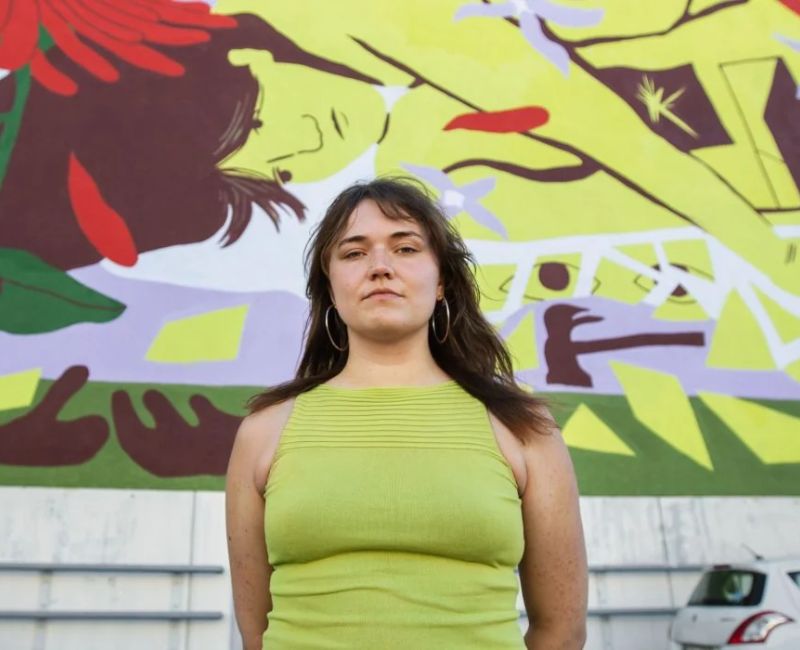
Jonna Bo Lammers is an illustrator, (reluctant) animator and muralist, and together with Lotte Masker, she forms the duo VAAF. Her work (and that of VAAF) has a disarming, colorful style that functions as “a kind of cheat” to highlight social and political issues, allowing for discussion and the breaking of taboos. Eye-catching, vivid works invite or challenge the audience to reflect on topics such as the sexualization of nudity, human rights, and the impact of sexual violence.
You could consider it a kind of radical openness to discuss these sometimes very personal topics through large murals in the public space, but it actually feels very natural to look for and emphasize the commonality of these issues. The silence helps nobody, so let’s go loud, bright and colorful instead.
I met with Jonna Bo Lammers on her 30th birthday and was wearing a party hat for the occasion. She demanded that this would be included in the final article.
This interview has been edited for length and clarity.
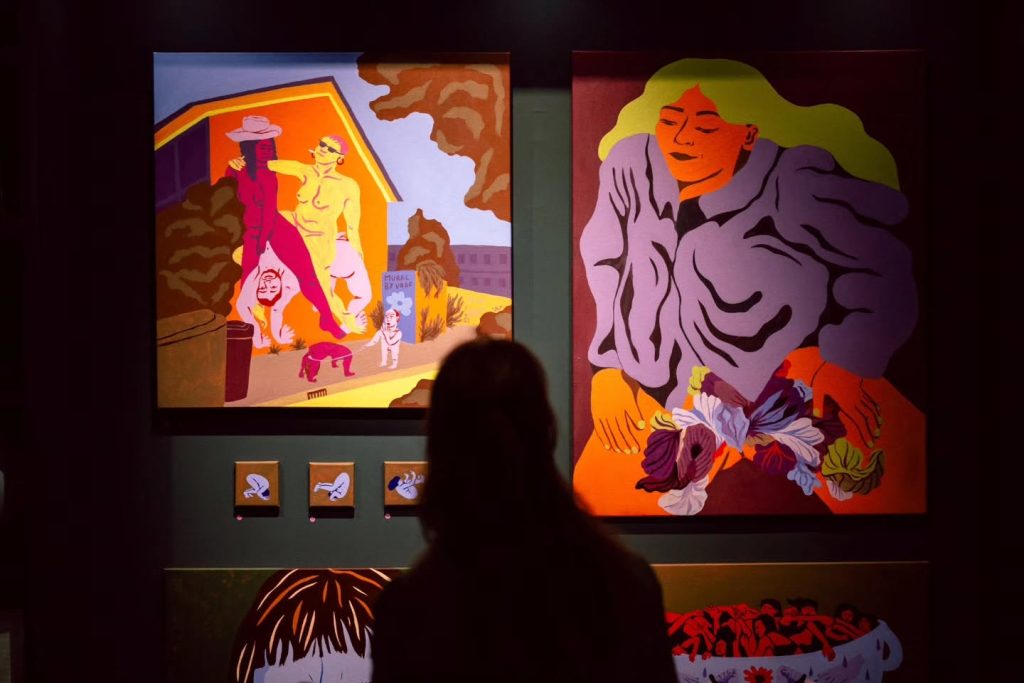
Happy birthday, and also congratulations with the opening of your exhibition at Wildstyle.
Thank you!
What was it like working towards that? How did the preparations go?
It was quite weird, actually. ‘Cause our work is solely focused on murals, and that’s work that can’t be sold. You also don’t choose to look at it, it’s just forced on you. And you’re not standing next to it to describe it to people. You don’t always do that at an exhibition either, but we were there at the opening, so it was very strange to be standing next to it. For a lot of artists it might be perfectly normal to talk about your work, but it really isn’t for us. So it felt really uncomfortable, but also it was a fun new experience.
Working toward it is also quite the story, because the person I work with, Lotte, her father passed away last year. He was sick for a long time, so she didn’t work a lot because she was dealing with that. And me… I was living on a houseboat until December last year. And that boat suddenly started sinking while I was asleep. Really weird story, but I lost all my stuff. I managed to get off the boat, but after that everything went under. So we both had a kinda disastrous year.
And we have a lot of murals that we want to make, that always get rejected, like ‘no, this is too political, this is much too feminist, there’s too many interpretation possibilities’; that kind of stuff. So we thought: ‘You know what? We’re just gonna do everything we weren’t allowed to do. And then we’ll just have a bit of fun, because we just need to have some fun this year.’
So we actually really enjoyed painting for ourselves. Not in the rain. No discussions with a client or a local council that feels compelled to get involved. So it was a nice process. It was also a lot, ‘cause we also just got a lot of new work in August and September. So we were quite busy. But it was so much fun.
Was it all new work in the exhibition?
Yeah, we don’t have any paintings at all.
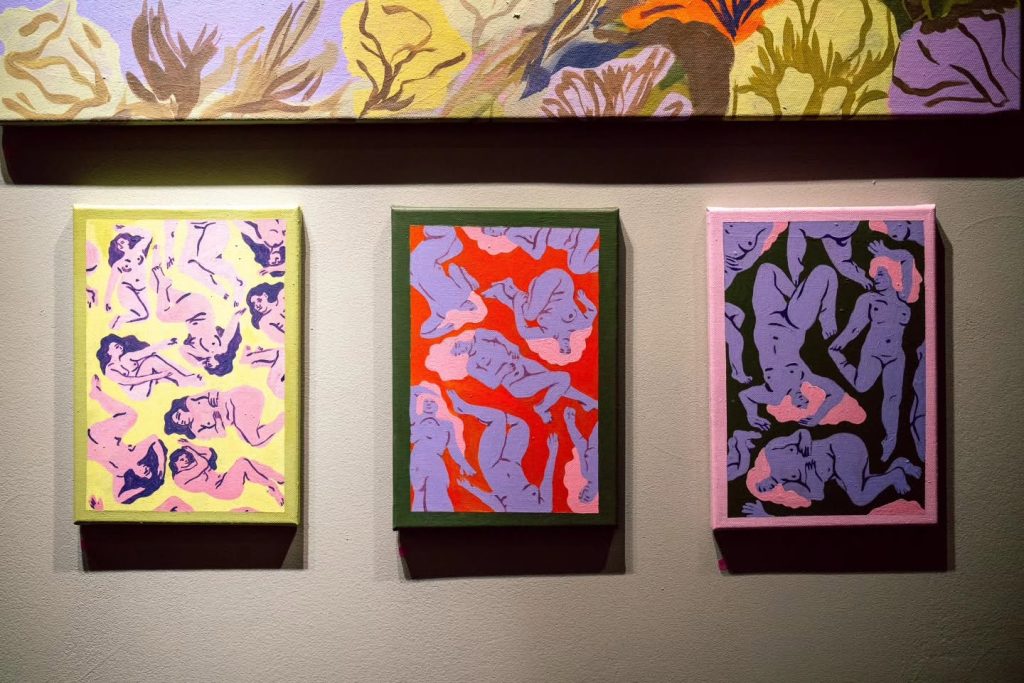
I think in my life… well, for art academy I sometimes made paintings. But I never had any money for a canvas. That’s why I started painting on the wall, because they would give free paint to paint over it again. And there was plenty of space, which is basically free canvas. Lotte did make some painting on canvas. But once we started working as illustrators and muralists… we were just always working.
We were told that we needed 25 works at least, so we thought ‘Okay, then we’ll just have to make 25 paintings.’ I think we ended up making 35 paintings, so we went a bit overboard, but at least it was enough. So we didn’t have anything, we just made everything in one go.
Did you start out with a clear idea of what works you were gonna make? Or did it all come about along the way?
A little bit. We do have themes we’re very interested in. One of the themes that we’re actually always concerned with – and it’s also to do with public space – is that you’ll see advertisements everywhere in public space, mostly with beautiful women who are selling products in a very sexual, objectified way. We mostly want to take that nudity, that’s being used as a kind of sexual thing to sell something, and normalize it.
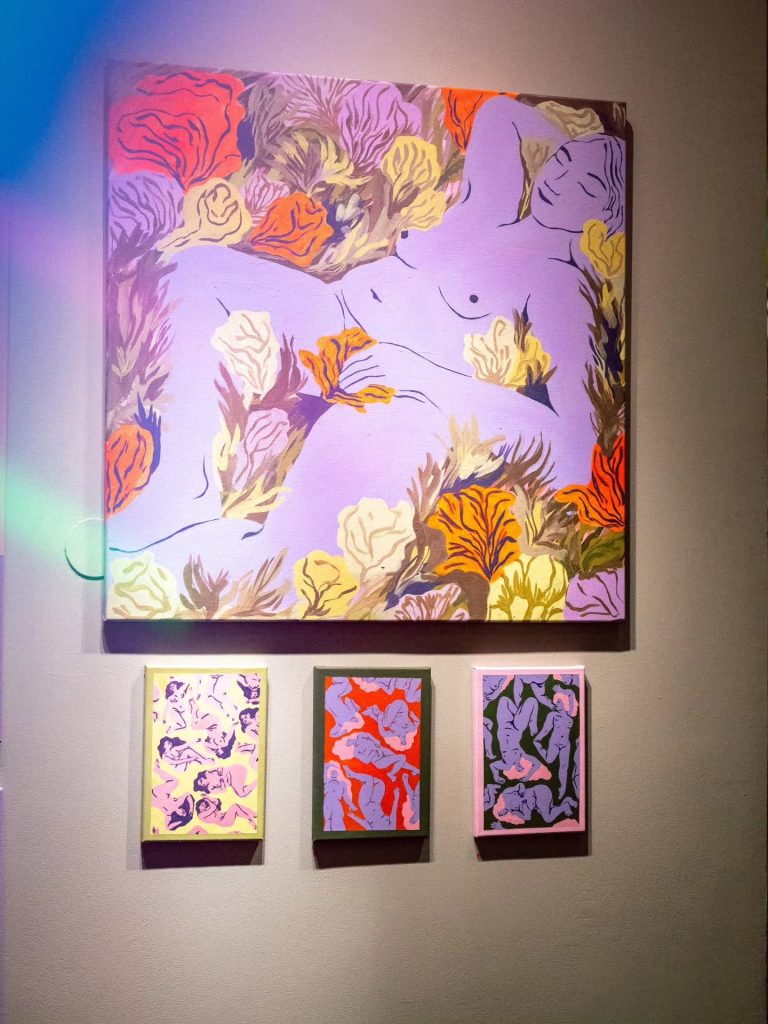
So we always stress that we don’t want to put any sexual nudity in our public works. Often that’s not allowed anyway, that’s ‘too many interpretation possibilities.’ But I also think that people are a bit uncomfortable with non-sexualized nudity – it feels weirder, more voyeuristic. And maybe they’re also just a bit prudish. But we felt like that needed to be a theme. So we made a lot of sorta playful nudes.
For instance, we made a series of small paintings of Lotte doing a forward roll, almost like an animation, also one in which a tampon string is hanging out. And we had large stickers of us lying on the floor naked. Because one time in Emmen Zoo, where the elephants used to be, we made a big nude painting of ourselves on the floor. We thought that was funny, kinda like ‘you’re walking all over us.’ But also because it was just a reclining nude.
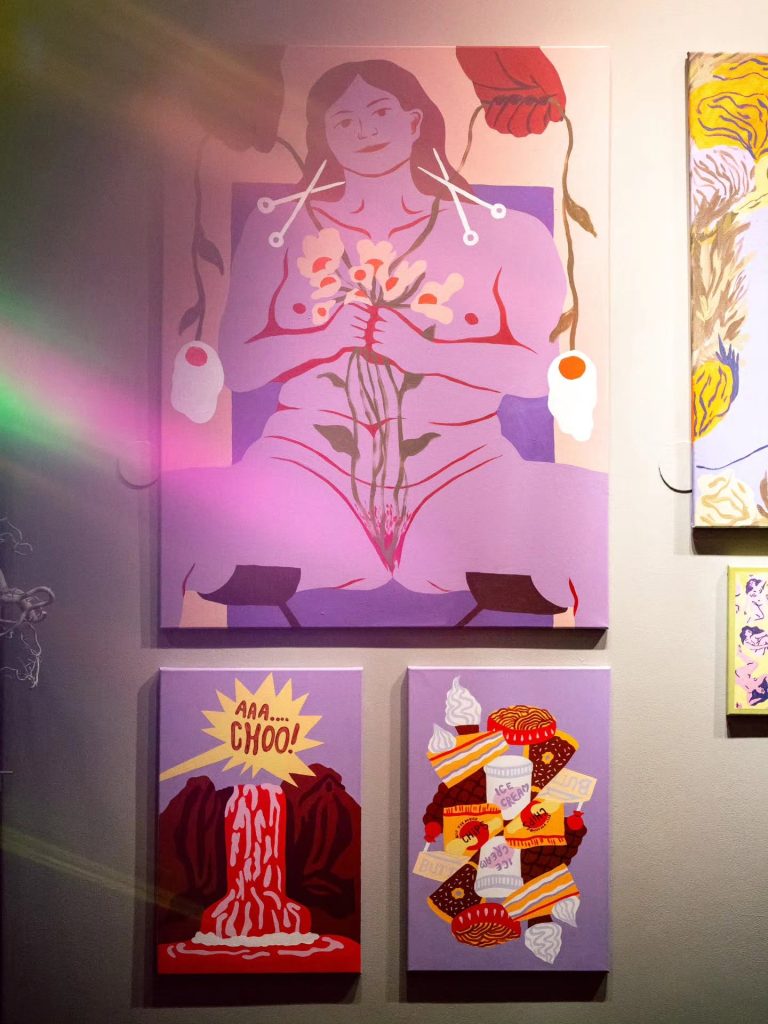
Those things we’d already thought of at the start, but most of it was also a little… another thing that also happened for example: three weeks before the exhibit opened, I discovered I was pregnant. And I don’t want children, so I had an abortion. I made a painting about that, because I also want to normalize talking about abortions. And because we’ve worked together for twelve years now, we have clear ideas of what’s important to us. So it went pretty naturally.
You live in Stockholm and Lotte in Groningen, the Netherlands. What did it look like to remotely start on those works together?
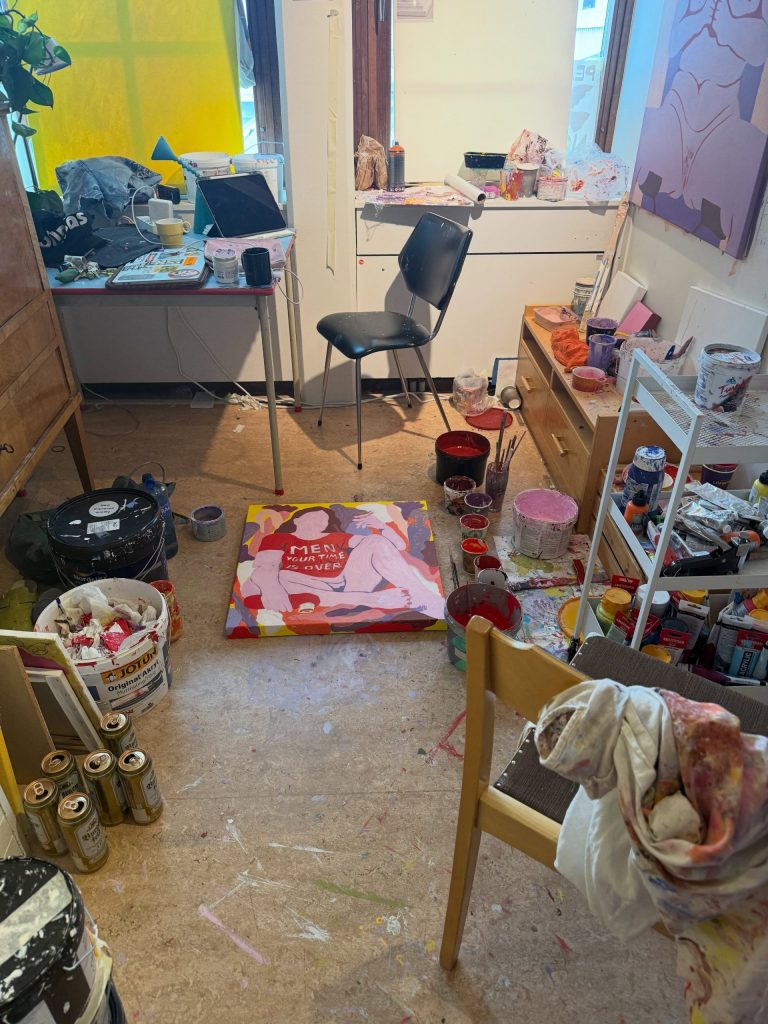
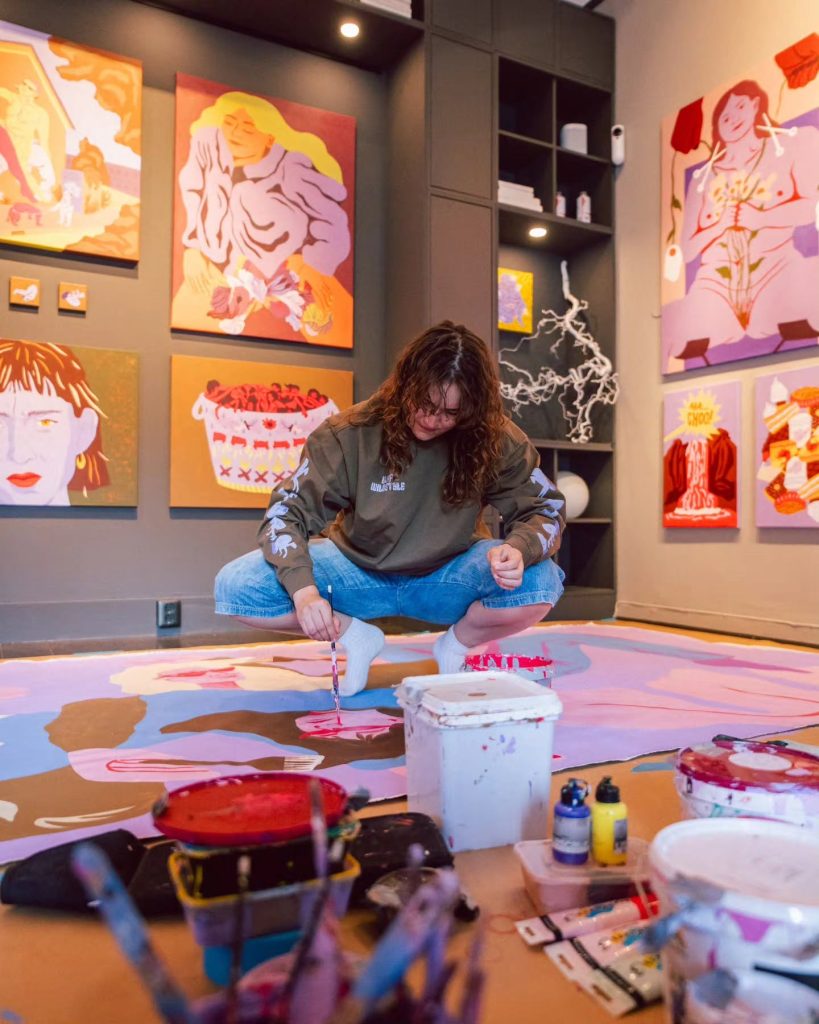
Usually we can work on a sketch together just by sending it to each other and editing it and cutting through it. But there’s quite a few steps from sketch to painting. So a lot of it was thinking of slightly broad subjects together, and then one of us would start painting it. Lotte also came to Stockholm to finish a lot of the paintings together.
But we also send paintings to each other the whole time, asking if the other would change or add something. We also refer to all paintings as ours. Even if only Lotte’s or my hand worked on it, it’s our work, because we really include each other in everything. But most paintings we worked on together, so taking a picture and discussing it on a video call. And when Lotte arrived we rolled out all the canvases, finished them and stretched them.
Did the real work look enough like what you saw over video?
Yes and no. No in the sense that Lotte is very tidy and detail-oriented. So she’s really good at editing those large murals by seeing how we can make something clearer at the end. And I’m good at getting that first idea done, but I have zero patience for all those details. So all my paintings were a bit messier, and you might not’ve seen that in the picture. So we had to deliberately make Lotte’s works a bit messier, because otherwise the difference would be too obvious. We always try to meet in the middle, but we’d never done that so literally.
When you were standing next to your work and seeing how people reacted, did it give you a whole new view of your own work?
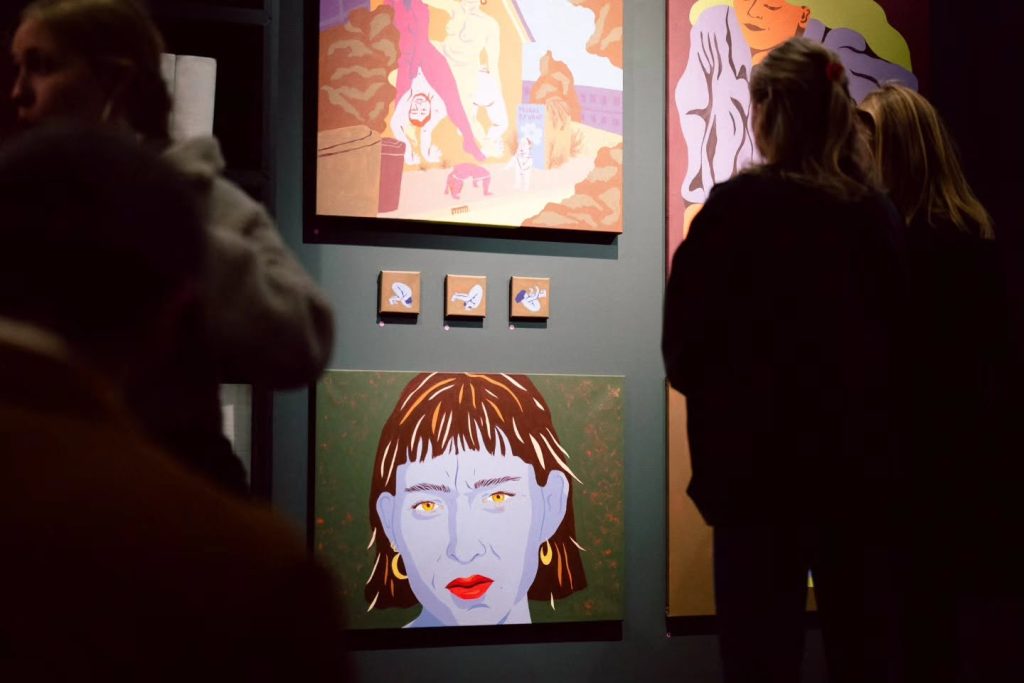
Good question. I don’t know. I think the reason it made me uncomfortable, and got a different view, is that people go to exhibitions to look at the art. And they give more focus to understanding it. Your work on the street is forced on people. They’re not choosing it. That also leads to very negative reactions, which I love: that I’m ruining the city, that graffiti doesn’t belong here – stuff like that. And then you have really fun conversations.
And now it was all ‘very good, nice use of colors.’ Then I get a bit curious and suspicious why nobody’s saying the things I usually hear on the streets. Are they afraid to say it? That might also be some of the discomfort, because I’ll think ‘Yeah, but if you really disliked it, you wouldn’t tell me.’ While people on the streets will just say it, because they don’t care who I am. All they’re thinking is ‘you are painting on my house.’
Funny how you’ve become used to talk about your work in a totally different way.
Yes, essentially when I talk about my work I have to explain it very simply. If people stay around a bit longer, then you can delve into it, but at the start you just need to be able to say what it’s about. Of course you can tell them ‘Well, have a look yourself’, but I also don’t want to seem too pretentious. Maybe they never look at art. I’d rather they get the self-confidence to determine what art is and isn’t. So then you say to them ‘Look at this for instance: I painted a woman, and she’s holding a flower. And oh, there’s also something curious happening.’ You’re kinda talking like that.
But at an opening, you’ll get questions like ‘what are your inspirations?’ Geez, I’ve never been asked that. No idea.
I was gonna ask that at some point, but I guess not…
Ha! Yeah, good question.
I am curious: when you’re making a big work on location, obviously it’s more sensitive to people walking by and the time. So how do you prepare something like that?
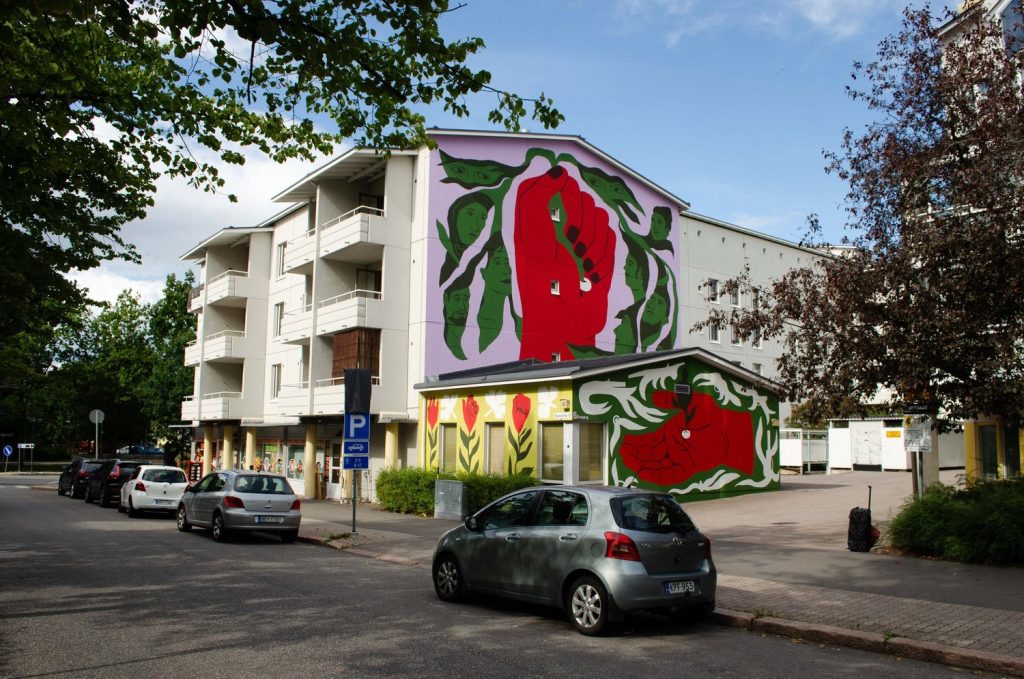
Of course there’s a lot of practical considerations. There’s the weather: it can’t be colder than 10°C, it can’t rain, and the wind can’t be too strong when you’re working with scissor lifts for example. Then there’s the kind of wall and which paint you can use. So that brings a lot of restrictions. Sometimes it’s also just speed: if we have a budget to use the lift for five days, then you simply have to get it done in five days. And you can’t work at night, because you need the light.
So there’s a lot of differences. And sometimes that makes it a lot less comfortable: standing in the wind, in the rain, sitting around inside until the weather app tells you the clouds have gone again.
But you also get live feedback from passersby and actually most people are just really excited. I’ve mentioned the negative responses, but a lot of people are overjoyed that something’s being made. They think it’s really interesting. So there’s also constant comments like ‘great’, ‘how nice’ and ‘what are you making?’ People are very interested, there’s a lot of interaction. You also get an immediate idea what people in the area think of it. To me, that’s more important than the building’s owner.
And making a painting in your studio, and having to decide when it’s finished, I think that’s also totally weird. We just move the lift aside and stand there looking at it, and there’ll be somebody walking by saying: ‘Wow, what’s this? Did you make that this week? And what does it mean?’ It really does give you a different feeling.
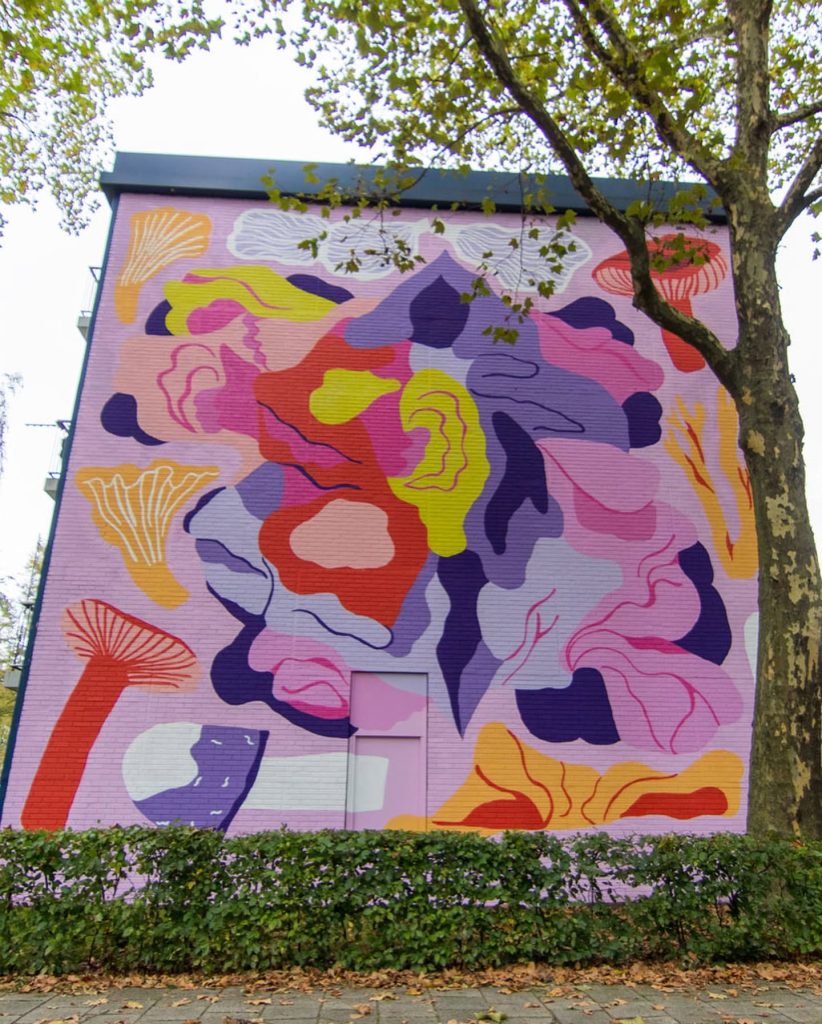
But you do have to prepare the final work somewhere. So I would think that you must’ve thought of a sketch or composition?
It depends on the commission.
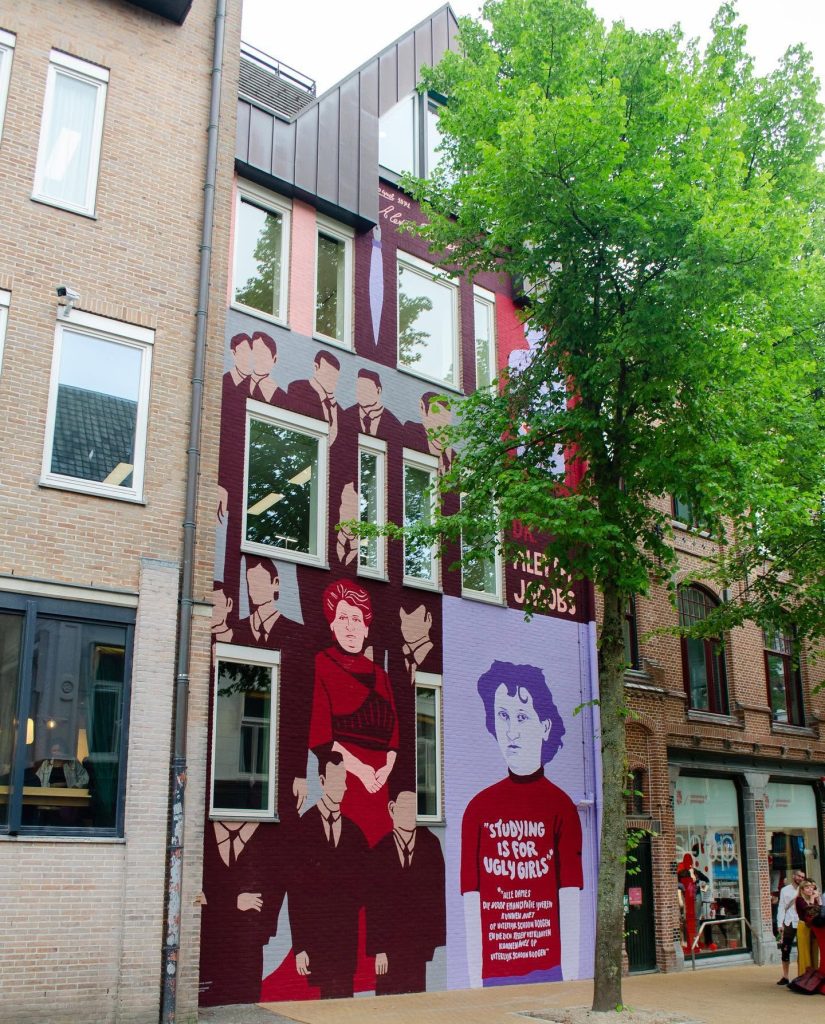
For instance, in our world there’s a lot of graffiti jams or mural jams. There, everyone is given a piece of wall, and you can do whatever you like. You don’t have to provide anything beforehand, you can just show up, create your work and then leave again. But with large walls, it’s always the case that you or the organisation hiring you – like Writer’s Block or Blind Walls or ALL CAPS in the Netherlands – has to present your sketch to the building’s owner or local council. Then you do get responses like ‘could her underpants be a bit bigger?’ or ‘this looks too much like a vulva.’ And then you need to decide if you’ll go along with that.
Do you have clear boundaries of how much you’ll go along with something? Or does it depend?
It does depend. I think often it’s a question of what would happen if I say ‘no.’ Will we lose the commission? It shouldn’t be about the money, but those murals will often be placed in neighborhoods where they really appreciate it, where residents really want them. So it’d be a shame if they didn’t get the mural. On the other hand: often you’re also gentrifying a neighborhood.
So it depends on what the purpose of a mural is and whether the change is non-political, like adding a little tree or slightly moving something aside. Of course that’s fine. But when they’re asking if some underpants could be a bit bigger, I do ask myself what the maximum size would be. Often I’ll send a design with the bigger underpants, and then just make them smaller again when we’re painting. Because nobody ever comes to check; they look at it on their computer, but they’ll never come by. So you can also ignore it a little.
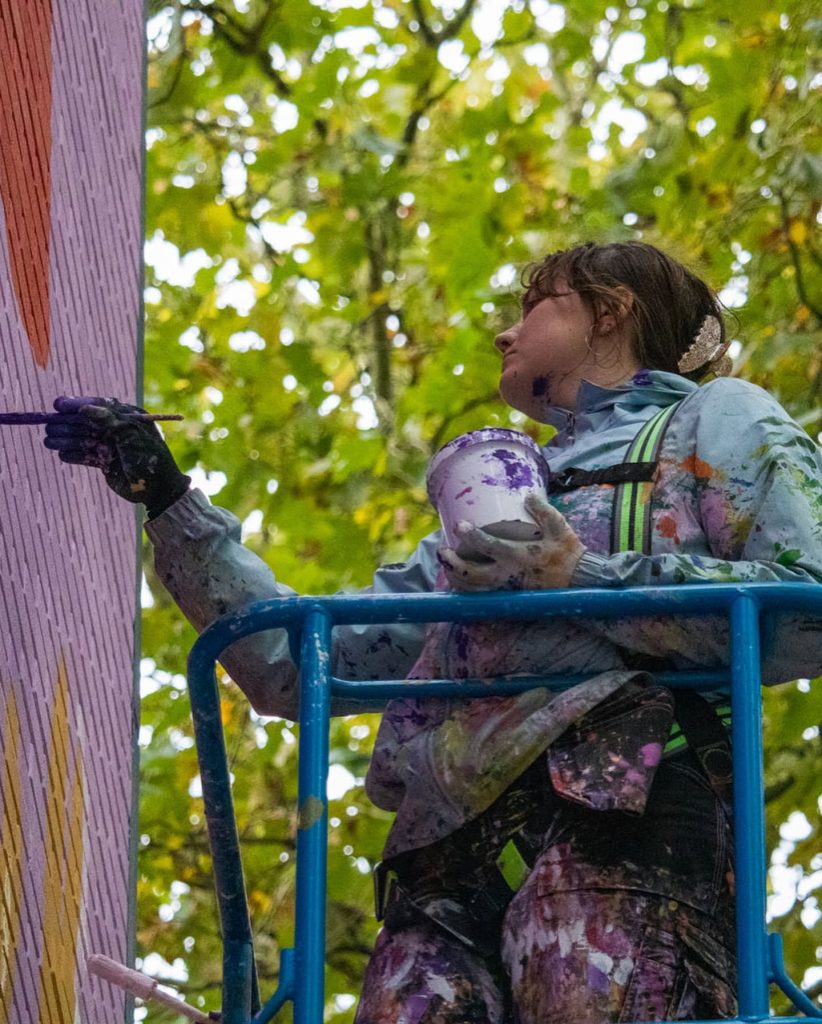
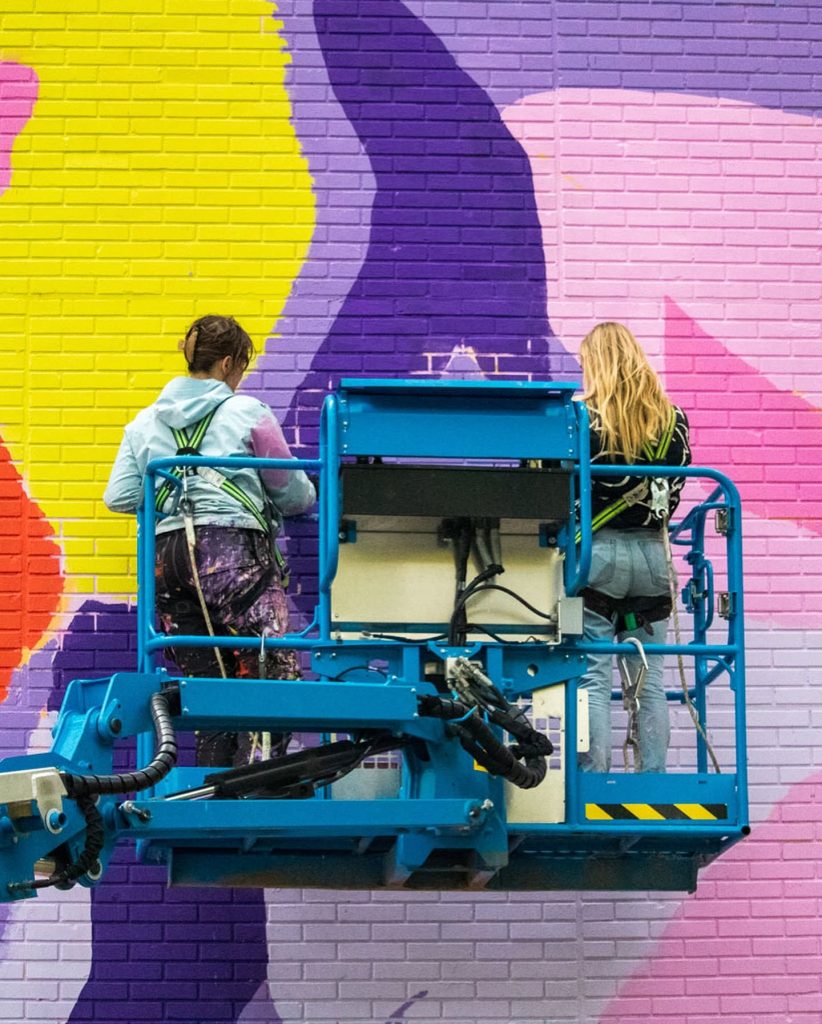
And adapting the sketch to a mural, is that really a matter of determining the dimensions? On paper it’s this big, so in reality it has to be this big?
Yeah, it’s pretty much one-to-one. Also ‘cause you’re often dealing with a window or a corner or something. You need to be pretty precise so a face doesn’t end up on a downpipe, because then that person is completely unrecognizable. But we’ll also make a lot of tiny edits, like when we arrive and discover a window isn’t 50 but 60 centimeters, or a plant has grown that wasn’t in the picture, or a generator’s been removed so we can add more details. With things like that, we can make some changes, but usually it’s pretty much exactly how we measured it. And we don’t work with a beamer or anything, but with a doodle grid. That’s an old graffiti method to quickly scale your design. It’ll be exactly what you had in mind.
You mentioned often interacting with commenting passersby. Are the conversations you have in the Netherlands different from the ones in Sweden?
Yeah, very different. Dutch people will just say things like ‘ruining the city!’ and ‘I don’t like it you know.’ Swedes are much more like ‘… okay, interesting.’ And that basically means ‘bad.’ They’re a lot more afraid of conflict. At first I thought it was because I didn’t speak any Swedish, but now I do speak Swedish and they really are more scared.
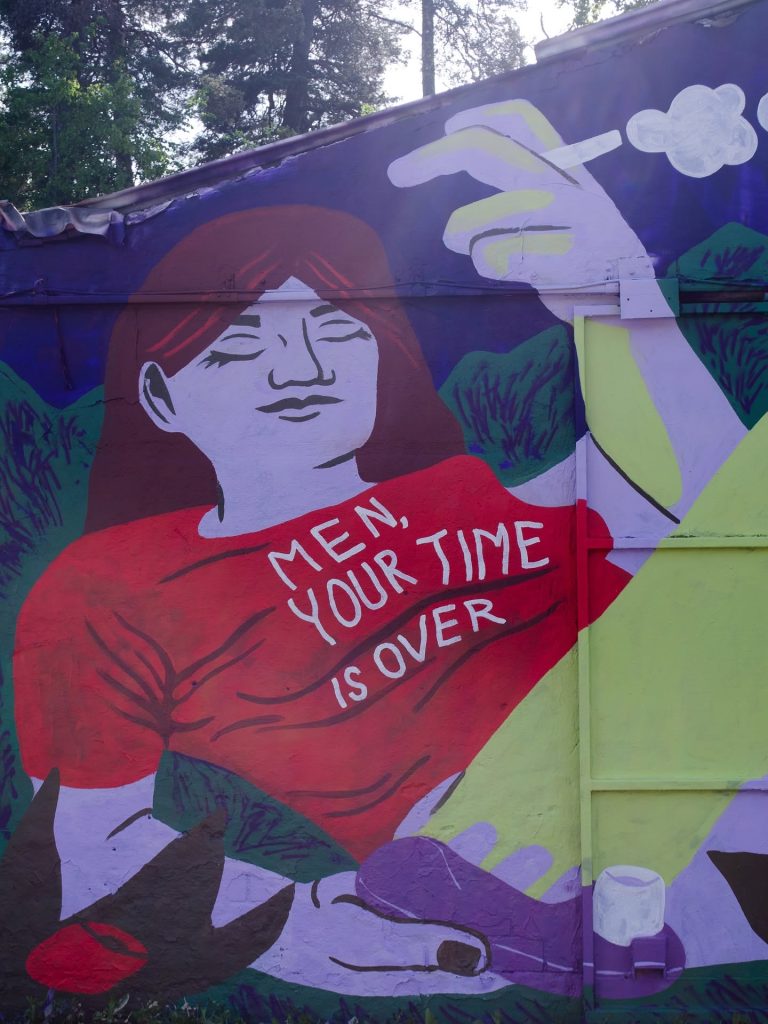
They’ve just had elections here, and the Swedish far-right party made a video of one of our murals, with their candidate standing in front of it saying “What in god’s name is this? What rubbish. It’s ugly, feminist piss propaganda, it doesn’t belong in public spaces!” But I saw him walk past while I was painting it, and of course he didn’t say anything to me, because he’s just really terrified of conflict. Afterwards they want to, but in the moment they’re much too shy.
Does that feel like fun publicity for your work?
So much fun! We even wore a shirt to the opening with that line, of the “ugly, feminist piss propaganda.” At first I really thought it was a parody, how anyone could think something like that. The first reactions as well were that the work should be painted over, but then it completely flipped: ‘Why are you making such a fuss, Jonathan?’ – they also started calling him by his first name. It was fun to see it unfold.
I also sent it to the gallery owner – ‘look at this!’ – and he immediately turned it into an advertisement for the exhibition.
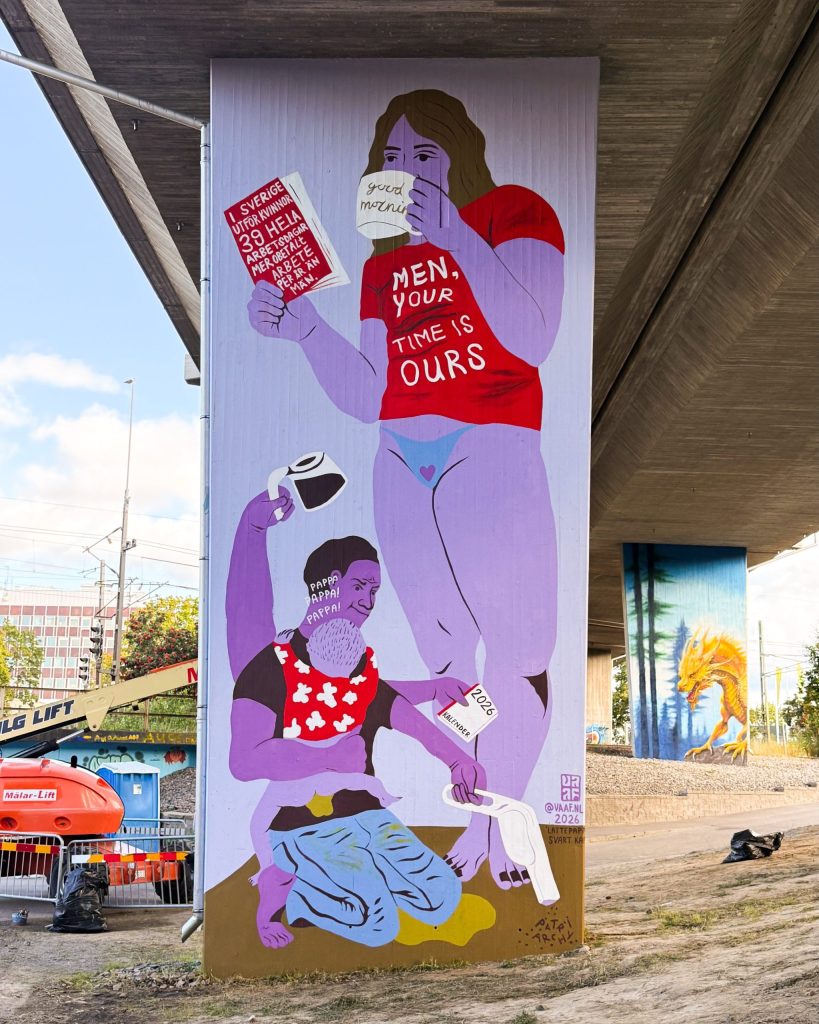
It does point to the political message of your work, which you also mentioned. Has that always been present in your work?
I do think it’s always been like that. But with murals, we’re often told it can’t be political. Like we’ll want to make something about human rights, or women’s rights, and they’ll call it political. But then Lotte will ask: ‘Is that political? Isn’t it just human rights?’ Some things we shouldn’t have to discuss; we shouldn’t have to discuss human rights anymore, it shouldn’t have to become a political issue. So we like to look at it more as working with human rights.
But sure, we’re obviously dealing with political choices as well. For example, we also painted in the asylum center in Ter Apel. We think that’s human rights, other people call it political. That’s always been a part of our work.
Among muralists, there’s a widespread view that a work really needs to be pretty, the aesthetics are very important. So we like using aesthetics to get our own political agenda across. It almost feels like a kind of cheat: you’ll see pretty birds, pretty nature, pretty portraits. And our work has very cheerful colors. But then we’ll still slightly let our own political ideas shine through. That’s not weird and nothing new of course; murals and graffiti have always had a political element. We’re just following the people that went before us.
This might still be the ‘inspirations question’ after all, but when you talk about the people that went before you, that you’re following, who exactly are you thinking of?
There’s two Swedish artists I’m thinking of, because of their guts.
Nug, a well-known Swedish graffiti writer. Coincidentally he did the same Master’s as me, and he graduated with a project called Territorial Pissing. For a long time Sweden had a zero tolerance approach; graffiti was very criminalized. At one point, you got a worse punishment for tagging a bus stop than if you fully demolished it.
Since 2015, that’s completely changed – they call it ‘post zero tolerance times’ now – but Nug would really challenge those policies. For his graduation project he got on a subway, and he started drawing on the wall with a marker. The marker got bigger and bigger, then becomes a spray can, and then a very big spray can. Next thing he smashes a window and leaps from the subway onto the platform. And finally he used a fire extinguisher filled with black paint to spray the entire subway car.
This is just vandalism, of course. It costs a lot of money to clean it up. But at that time it was a huge middle finger to the police and zero tolerance. And a very daring video, especially to produce it within a respected institute as the Konstfack. Having the courage to do something like that is hugely inspiring to me.
Then there’s Carolina Falkholt, also a muralist from Sweden. She’s very connected to the streets and the working class, very down to earth, and she still makes a lot of illegal works. In 2017, she painted a giant erect penis on a wall in New York. It was removed after ten hours, and then she said on the news that nobody would care in Sweden. So she painted a huge blue penis in Stockholm city center. The work is called Fuck the World and was removed after ten days.
And there’s this video in which two women – slightly older women – are being interviewed about the work, because there was a lot of commotion and plenty of valid criticism. And that video is the reasons I learned Swedish, because these women are laughing and keep saying: “I like it, actually. I think it’s funny. In our days – how we were raised – we weren’t allowed to talk about these things. ‘Penis!’ Words like that. ‘Penis!’ We weren’t allowed to say that at all! That’s why I think it’s neat that they just painted it on the wall like that. Yes, Swedes also are just a little crazy, a little funny, a little free – should all be possible!” Two little ladies with those pearl necklaces! She’s always been very purposeful about exploring the limits of public art and murals.
That’s why I really like them. At the same time I’m also very critical of them, because I think there’s also a lot of wrong works. But to me it’s just so cool what it brings about: that things become public debates, and people get a sense of ‘I can say something about that, I will say something about that, I have an opinion about that.’ Not people staying silent because they think they don’t get it, but immediately having a strong opinion and taking to the streets, interviewing people, covering it up – it gets so lively. I just think that’s cool.
Do you feel like the nudity in your work contributes to it also generating such strong reactions?
Yes, without a doubt.
Something like Fuck the World, a big penis like that, that’s also a bit of a middle finger. And it being blue, a kind of alien penis, I always thought was interesting to dissect. There’s something about provoking that I just really enjoy. But the nudity, the reason we do that isn’t to provoke. Rather we want to normalize it, actually.
Here there’s advertisements on the train, on the bus, on the subway, everywhere. I think it’s slightly less in the Netherlands. They‘re given a lot of room to show anything they want, and often they sell a kind of sexuality. We want to show non-sexual nudity in our works as a form of opposition to the sexual nudity that’s trying to sell you something.
So where’s the line between sexual and non-sexual nudity?
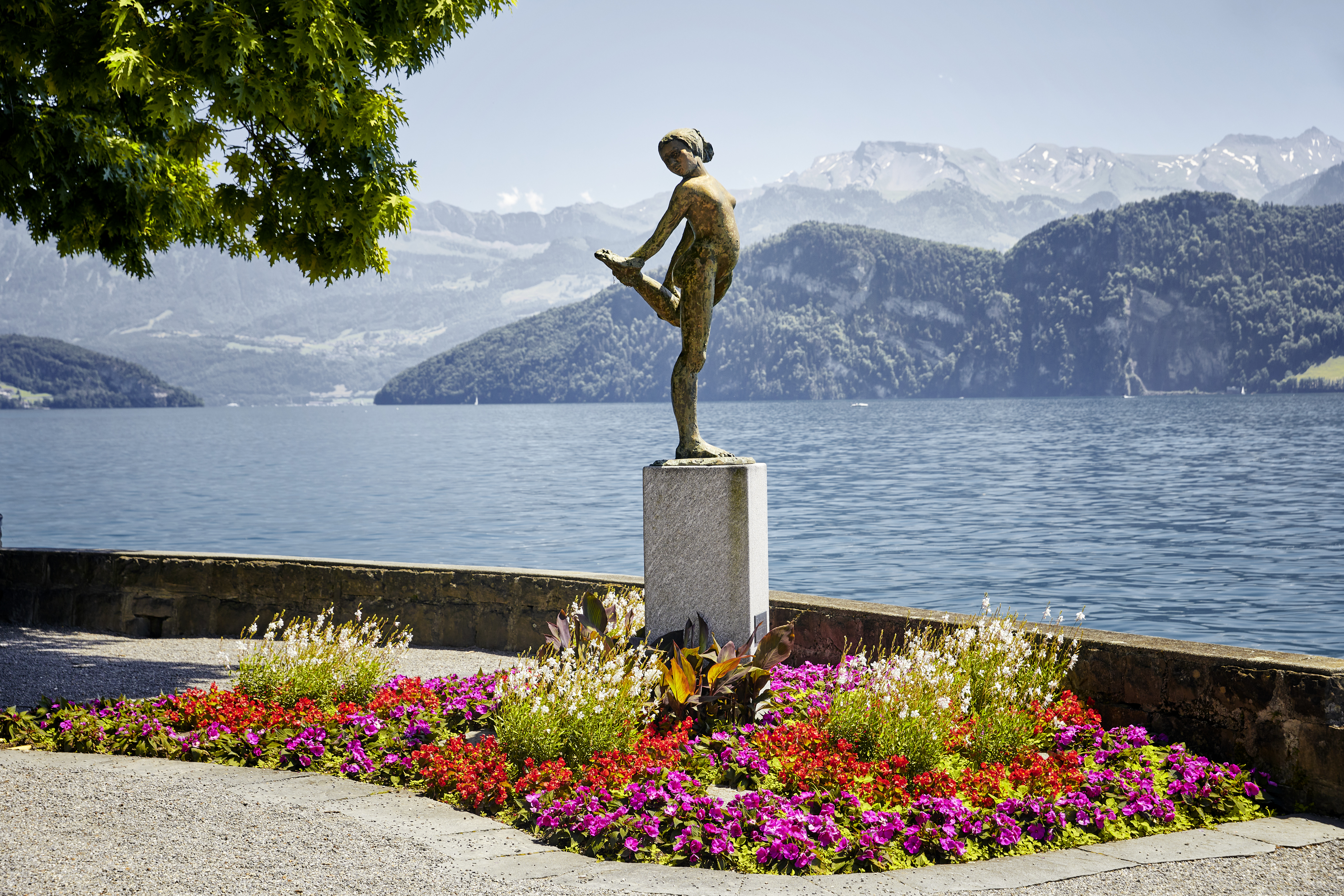
I love the documentary Ways of Seeing by John Berger; it’s from 1975 but feels like it could’ve been made yesterday. It does a really good job explaining when somebody’s naked for the viewer instead of for themselves. And in a lecture just now I showed all these statues in Lucerne, ‘cause we weren’t allowed to paint a nude there, just of a reclining woman, while just a stone’s throw away there’s a statue of a woman standing like this. I’ve never stood like that for myself, you only do that to show off your body to somebody else. It’s a feeling as well, but you can also base it on that: if I was combing my hair, or stretching my back, or trying to feel good, would I also look like that? Or is it just to show nudity?
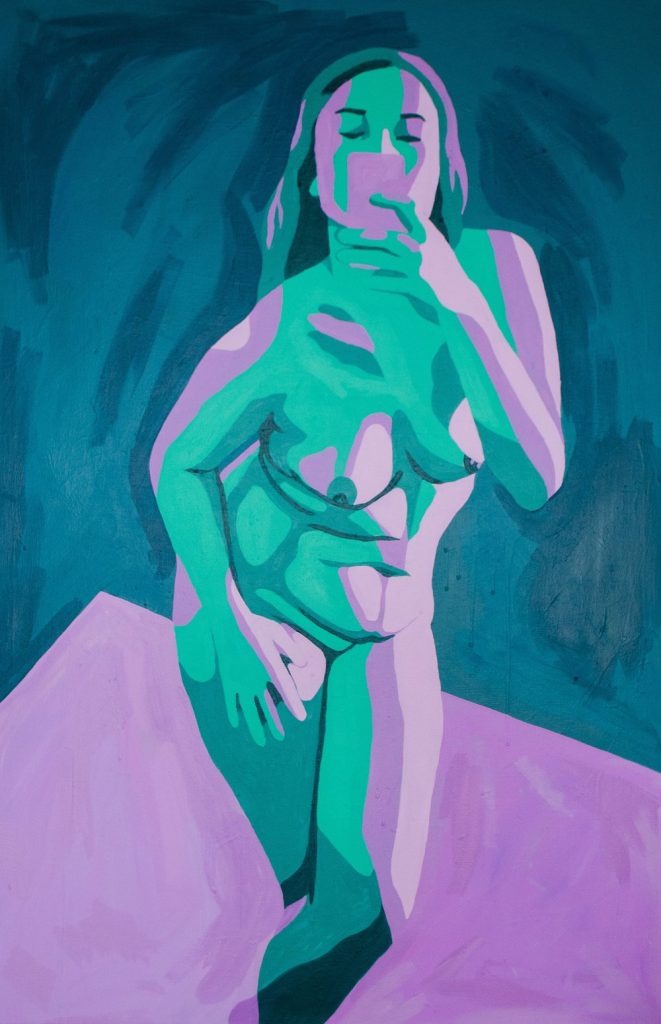
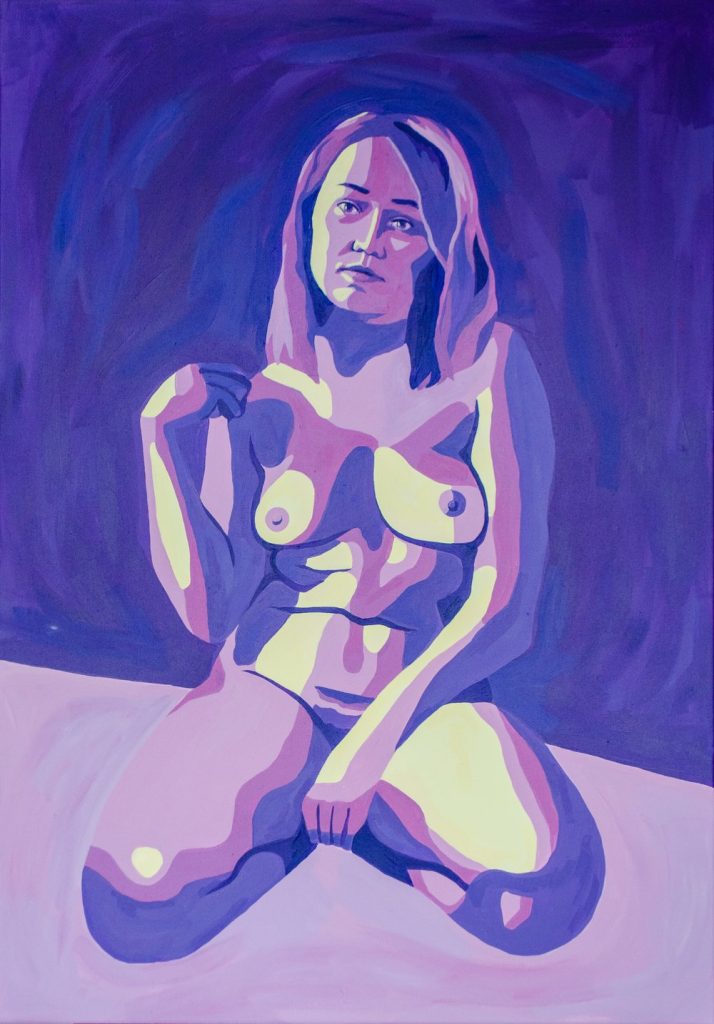
You’ve also shared naked self-portraits online. Does that feel very vulnerable, or do you find it can also give you a lot of strength?
Ah, that’s a while ago. I remember there being a TV program, ‘Gewoon. Bloot.’ (‘Normal. Naked.’), and people started complaining it was pedophilia. It was a program in which a group of kids could look at naked adults and ask anything – ‘why does your sack hang so low?’, stuff like that. And I really enjoyed it, because it normalizes the nakedness. I’d already made the paintings, and sharing it was more in response to that, because I thought it was completely ludicrous that we immediately see people with no clothes on as sexual violence against children.
It did feel scary, but that’s gone now. We also had a lot of naked portraits in the exhibition. You can’t necessarily tell it’s us, but if you keep looking at my face you’ll recognize it. At this point it feels great, very liberating. Now I’m really practicing what I preach, and that’s nice.
It doesn’t always have to be like that. You’re allowed to say: ‘I want to be naked more comfortably, but I can’t.’ That’s alright as well. But I have reached that stage, so that’s pretty tight. Now it doesn’t phase me as much anymore.
Is there a difference between painting yourself naked and painting somebody else naked?
It’s always a bit more difficult. I’m fine with positioning in whichever way, but when I ask somebody else to model, I can tell they start self-objectifying. I’ll tell them “Just sit how you usually sit”, but they won’t want to be portrayed like that. So you’ll have all these restrictions of how comfortable they feel with something. I also don’t have a lot of friends who’ll pose for each other, I just ask friends who work in marketing or whatever, so it’d probably be different if I had more friends who pose naked more regularly.
By painting myself naked I suddenly became one again, because normally I’d look in the mirror at things such as disliking my belly, or my knees, and I’d be totally fragmenting myself – all little pieces of me. And when I started painting myself I thought: “Oh, the shape is actually kinda nice, the bubbling of the skin, it looks interesting. Fun to paint as well.”
I also started offering that to other people who struggled with their body. A friend of mine, Sanne Schoemaker, then made a short documentary about it. She called it something like ‘whole nudity’, because she saw herself as a whole person again.
If I ever break my leg or something, if I can’t paint again, then I’d like to pick it up again. But I also many others would be much better at it, but fine. It was really nice to do.
So it’s not something you’d immediately continue with right now?
Well, I’ll be moving in with a good friend soon, and she’s very free and open. If I need a model for our next mural, I think I’ll ask her. Also to change it up a little, so it’s not just Lotte or me. Because in our work it doesn’t really matter if it’s us, especially in our public works, we just want somebody that people could see themselves in.
How do you make up that person?
Usually looking around outside for a bit to see the kind of people walking around. I really want people to be able to recognize themselves, so it’s good to choose someone who looks a little like the people walking down the street. But you could also go for something entirely different. Our works don’t have clear one-to-one resemblance, we use a lot of abstraction, a lot of colors, very stylized, illustrative. So it’s also going through that lens.
But we do want to give people a sense that it might be them painted on the wall, or it could’ve been. It’s their neighborhood as well.
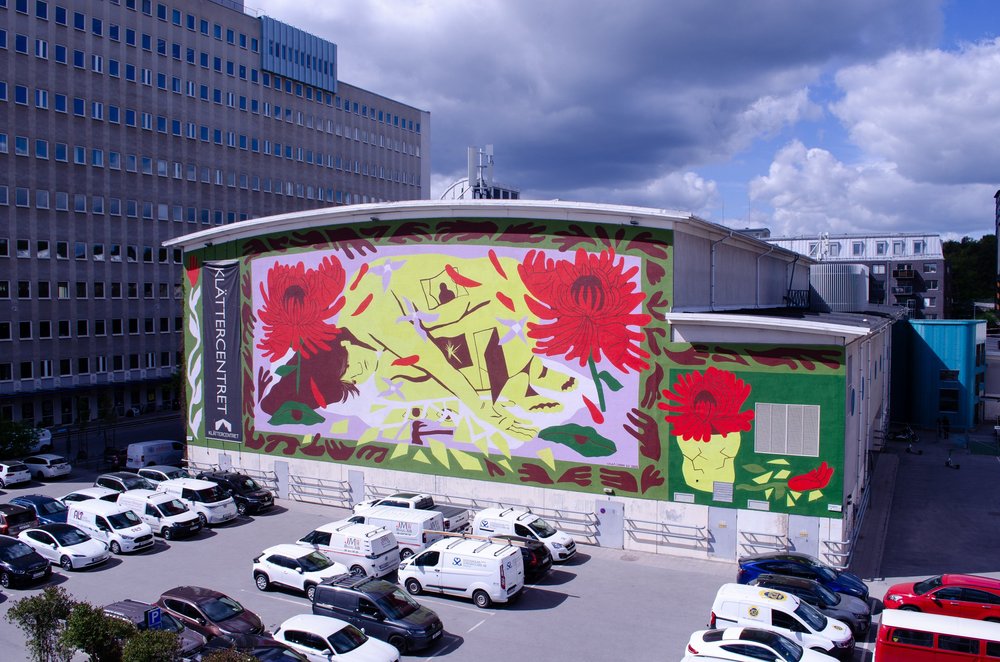
Did your style – very illustrative, a lot of colors – come about gradually, or was it clear pretty quickly that this would be it when you started collaborating?
Both of us really love color: how certain colors complement each other, and how much impact it has. It really draws your attention. And we like to paint difficult or painful themes with a lot of color, to challenge the idea that difficult subjects should have dark colors, and happy subjects bright colors.
For example, I made a mural here in Stockholm about the impact of sexual violence. And it was made with a lot of color. That’s also a practical thing, to light up the surroundings a little, because those colors reflect a lot of light. So at night, it becomes much brighter and safer for people on the street. And the area becomes more colorful. But it’s also to lure people in to look at these kinds of difficult subjects, and it works really well for topics like sexual violence.
I also made a mural about a man who was jerking off to me on the subway. The way people looked at that work – it had all these colors, roses, ornaments – actually mirrored how I felt when it happened. Because on the subway, I saw a man staring at me intensely, and I just thought it was a lonely, sweet old man. But then I noticed he was jerking off, and I ran away. And people looking at that work also reacted like: ‘Aww, how nice, how nice… Oh. Ohhhh…’ Almost exactly the same experience that I had. I thought that worked nicely.
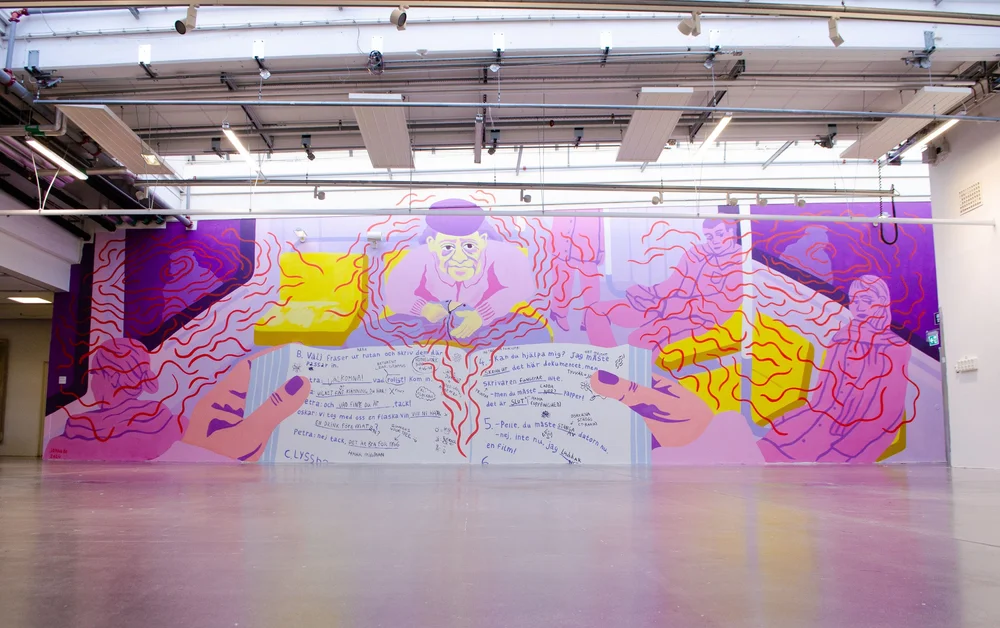
You’ve made several works and conducted research based on your own experiences with sexual violence. Was there also a weird feeling in portraying such experiences in a very colorful way?
Yes, at the start it did feel like it wasn’t right, or that it was disrespectful. Then I also started making the works very dark myself, but that made it very intense and heavy, and I stopped. So I made a kind of compromise with myself: I’m just gonna paint in neon colors. That did work. So it’s also a practical consideration.
It’s such a huge taboo, and I think we really should just accept any way that we can talk about it. Even if it’s in vibrant colors. If it helps to make it more visible and easier to talk about, that’s most important. Because first it happens to you, that’s like the first punishment, and then the second punishment is you can’t really talk about it because people do find it a bit uncomfortable. So you get two punishments for the price of one. It’s simply not fair.
This weekend you’ll be attending the Dutch Film Festival, because your music video for ‘Het Zou Zo Mooi Zijn’ by Irene Wiersma is nominated for a Music Video Award.
Yeah, when I read it, I kinda thought it was a joke or a mistake. I love the animation, and I love the song, and Irene is an incredible singer-songwriter. But it’s my first animation, so I can clearly see the rough edges, and that’s why it shocked me that I was nominated. I believe Irene also submitted it to New York and Berlin, and there it’s been nominated as well. So I’m still surprised that apparently it’s so touching. But yeah, fun!
For the animation, I discussed with Irene that I really wanted to animate the feeling of sexual violence and its impact – how you carry it with you into safe spaces, like your own bedroom. Because sexual violence is communicated in a very one-sided way, the visual language is almost always about saying ‘no’ and being sad. You can also see that in my work. But I really wanted to grasp how it feels when it’s happened, and you go home, to your room – how the carpet between your toes feels like fingers, and your blanket is touching you as if you’re being groped again.
How did the collaboration come about?
I was already working on this projects during my Master’s, I had also shared it online. And I was working with Deborah Fidder, who’d made documentary, Ve(e)rkracht (Raped/Resilience), about the impact of sexual violence and how the people around you should react. You can see me in the documentary making a mural, and I made some illustrations for the crowdfunding and film screenings. The people working with sexual violence in the Netherlands, are all slightly connected with the Sexual Violence Center and Iva Bicanic. They’re all familiar with each other, so that’s how we ended up together.
I was just thinking that it’s actually kinda strange, because I’d never made an animation before. But she just asked me if I wanted to give it a try, because she loved my work on the subject. In a way it was the complete opposite of how most clients work: she picked me entirely on the concept, not based on the medium.
And how was the animating itself?
It fucking sucked. Holy shit, the amount of drawings you have to make.
I’m also awful with technology. Initially it wanted to do everything analog, because that I understand, but my computer couldn’t handle scanning all those things, and I accidentally scanned some paper the wrong way, and I was just about to throw my laptop out of the window. Then I ended up asking some friends how they do it, and they said: ‘Jonna, you’re gonna use Toonsquid.’ It’s a program that allows you to make frame-by-frame animations on your iPad – you grab a pen, you start drawing, and that’s it. No hassle.
Now I’m very happy with it, but as I was making it, I absolutely hated it. So much work for so little. And I only did line drawings, I can’t fathom how people make something like that with colors and shadows.
It must be really weird having to draw your own style on an iPad.
Very weird indeed. Very difficult.
I’m so happy with the animation and that I did it. It was also one of the best collaborations I’ve ever had – aside from working for VAAF with Lotte. But after that I really just thought: ‘I’m never doing this again.’ But then I got nominated, and you do start questioning what you should do. It also felt like a baller move to make one animation that gets screened at the Dutch Film Festival, and then never do it again. So we’ll see.
If somebody approaches me for an animation project that really fits my ideals, that really feels important, I’m always willing to do something. Like if I had to make an animation about the representation of intersex people; it remains overlooked. Then I get a sense of duty. But if somebody asks me to make a music video for a band I kinda like, I’d have to think thrice.
I think it’s time for the final question. It might be a big one, but because you’re celebrating your 30th today: which art work, by you or someone else, really shaped your twenties?
Interesting.
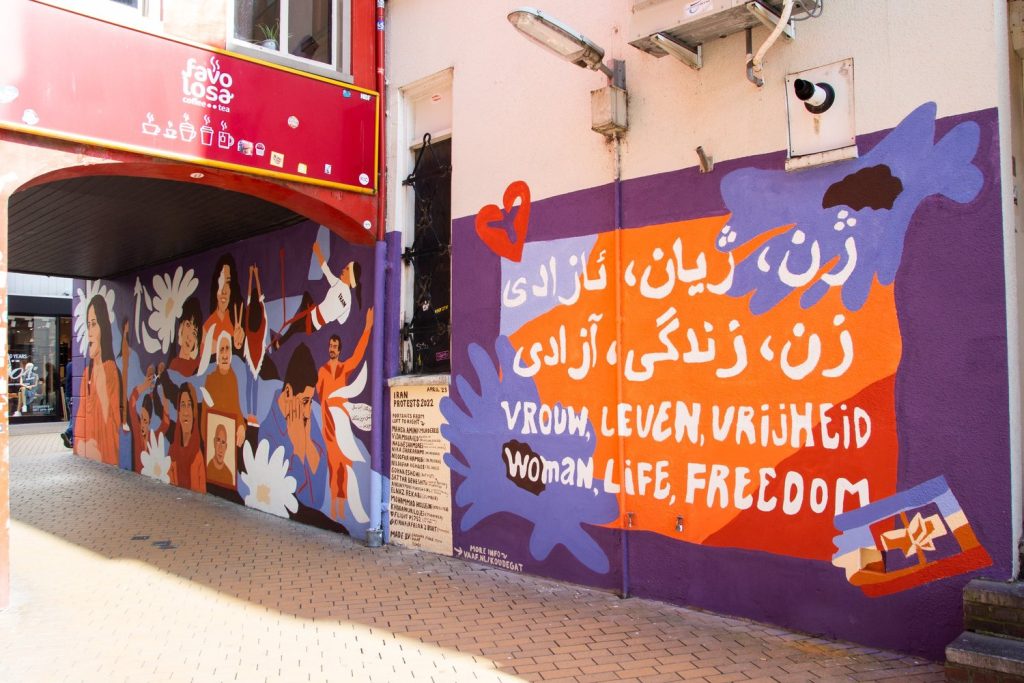
I think the mural we made in the Koude Gat in Groningen, in honor of Mahsa Amini and many other women – and men as well – who were killed or mutilated by the Iranian morality police. In a sense, we didn’t design that mural ourselves: we painted the portraits and did some composition, but determining who should be on it, that was mainly a friend of ours. Well, she’s a friend now, at the time it was just somebody writing to us on Instagram: ‘I am Iranian and I hate feeling so powerless about what’s happening right now. I really want to do something, so could you make a mural?’
We really fought for that painting, to get the permit and to get free paint. And we painted it together with almost 40 Iranians and people of other nationalities living in Groningen. It really gave me a tangible sense of the impact our murals can have. Every year after that I saw that people would lay down flowers for the death of Mahsa Amini and many other women and people included in the painting. And I saw how emotional and grateful everyone who helped was. It made me feel amazing, but also gave me a sense of duty, almost of power: who gets to see what in public spaces?
In my early twenties, I was more concerned with fun, cheerful little things. As I got older, I started feeling that I work for others. I don’t want to present myself as an artist and a genius person, rather I am a kind of medium. I’m a kind of tool: I just see things I find important, and then I really want to help and break certain taboos and give people a voice.
More Jonna Bo Lammers:
Turning the Tide residency
Interview in Perestrojka podcast (in Dutch)
Interview with Kunstpunt (in Dutch)
Website