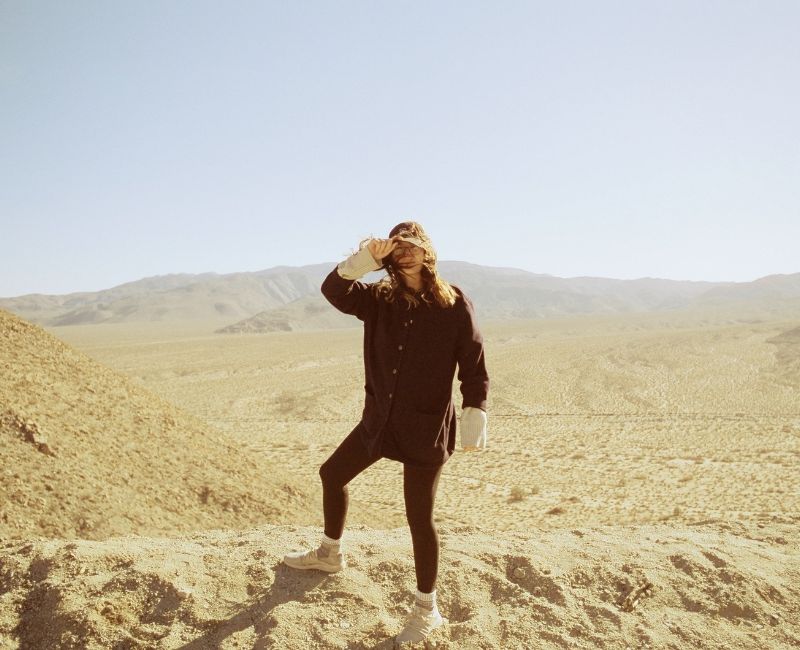
The work of visual artist OK Pedersen can best be described as image-making, combining personal and archival material to create new realities or echoes from a world that maybe never existed. Pedersen finds threads among the vastness of our (un)collected memories, repurposing and recontextualizing them to show that our histories and the grand narratives of our world are not fixed or definitive; they are unstuck, interpretable, and too often disconnected from everyday life.
I discovered Pedersen’s work through her excellent music video for ‘Keys Down if You Stay’ by Cola – one of my favorite songs of recent years. The video revolves around ‘cost of living’, capturing the bizarre state of the housing market and how the promised endpoint of home-ownership often remains a fantasy that quickly collapses under the weight of our capitalist reality.
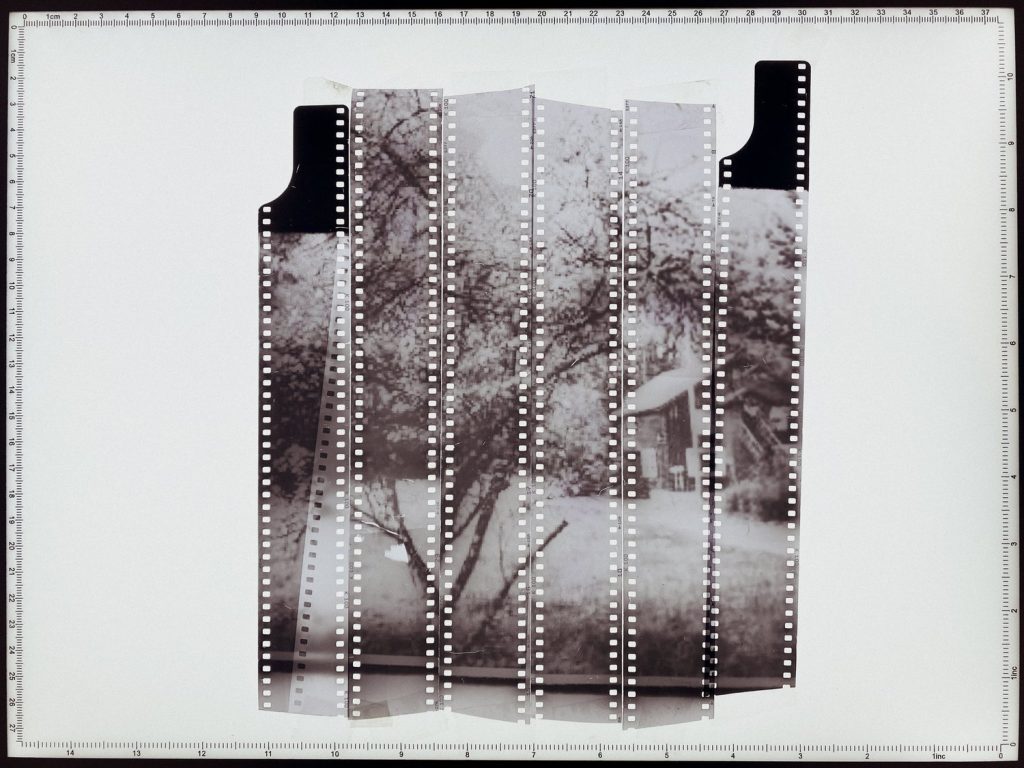
I’m curious about the first work shown on your website. Where is this image from, and what inspired the work?
That image is a process image of what eventually became a piece called The Exit. It was a little darkroom experiment I was doing last year where I would expose an image onto a roll of 35mm film laid out in strips. The source image is a digital image from a real estate listing of a dream house of mine. So first I made the internegative of the source image by rephotographing the digital image onto black-and-white 35mm film, which I hand-processed in the darkroom. And then to make the piece, I used an enlarger to expose the internegative directly onto a full roll of film. It was quite a tedious process and took a lot of tests, because you have to cut and lay out the receiving film in total darkness. And then I hand-processed the film on the spot, and the image you see is the final film strips laid on a lightbox. I then made a transparency print of the film strips and mounted it on a modified antique exit sign – so it became a kind of functional lightbox – mounted above the door at my exhibition Orchard Station Road at Centre Clark. It’s a dream house of course, we all need an exit plan.

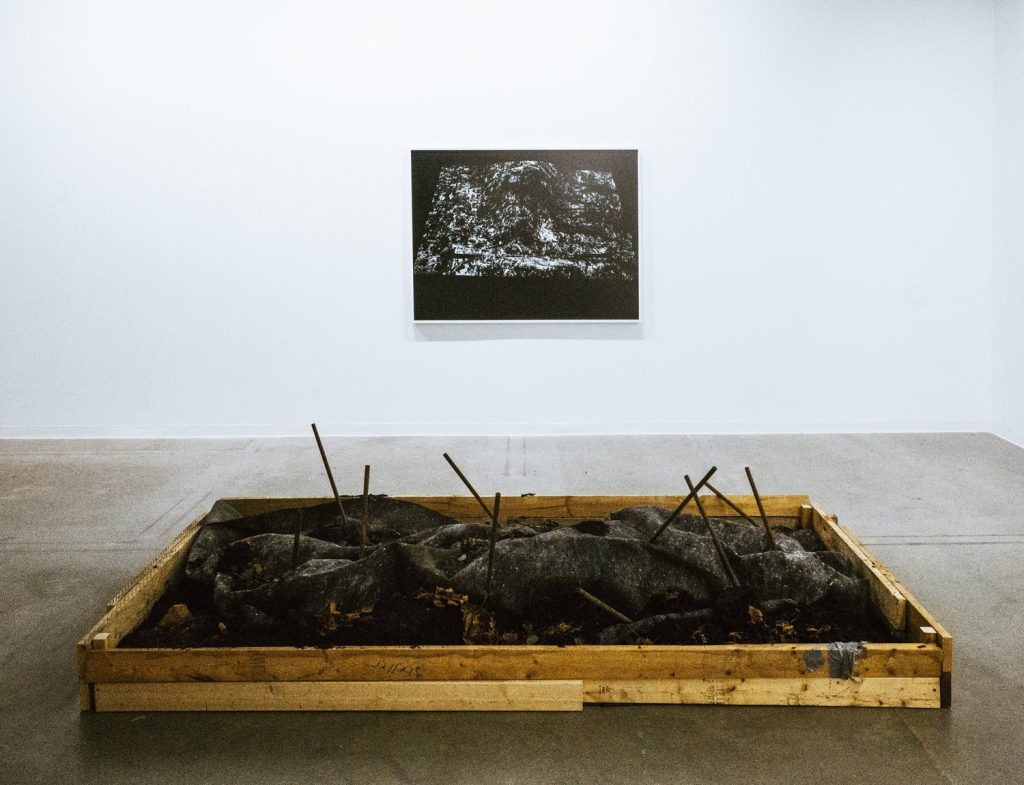
Looking at Easement, I couldn’t help but feel a sense of violence contained within. Could you tell me more about this work?
Easement was a work I made in grad school when I was studying photography. In grad school you have a lot of space, actual physical space, so one is inclined to make big art. The first iteration is an exact replica, with real found materials, of something I actually saw on the streets of Montreal in my first months there. There is famously a lot of construction in Montreal and to a newcomer it’s sort of dreamy (this wears off). So the easement is the bit of green space on the sidewalk where there is usually a small tree or something, every ten meters. But this one was all fucked up and full of construction materials because they had torn up the street, and it was so intensely sad in a way, or yes, violent. The churn and debris of Progress.
Instead of just photographing it I wanted to recreate it in the gallery space, which I did for the first time in the fall. And then in the winter I recreated it again in another space, but winter-ier. And then I finished grad school and I had all these bags of dirt and mulch that I had to remove from my studio, so I wanted to bring the piece back to real life. I recreated it again in the spring on my street, where there was an actual easement with an old tree, and planted some wildflowers. And then made the last photograph of it at the end of summer, in full bloom. And then when fall/winter comes the city destroys these things with the snow plows and you start again next year.
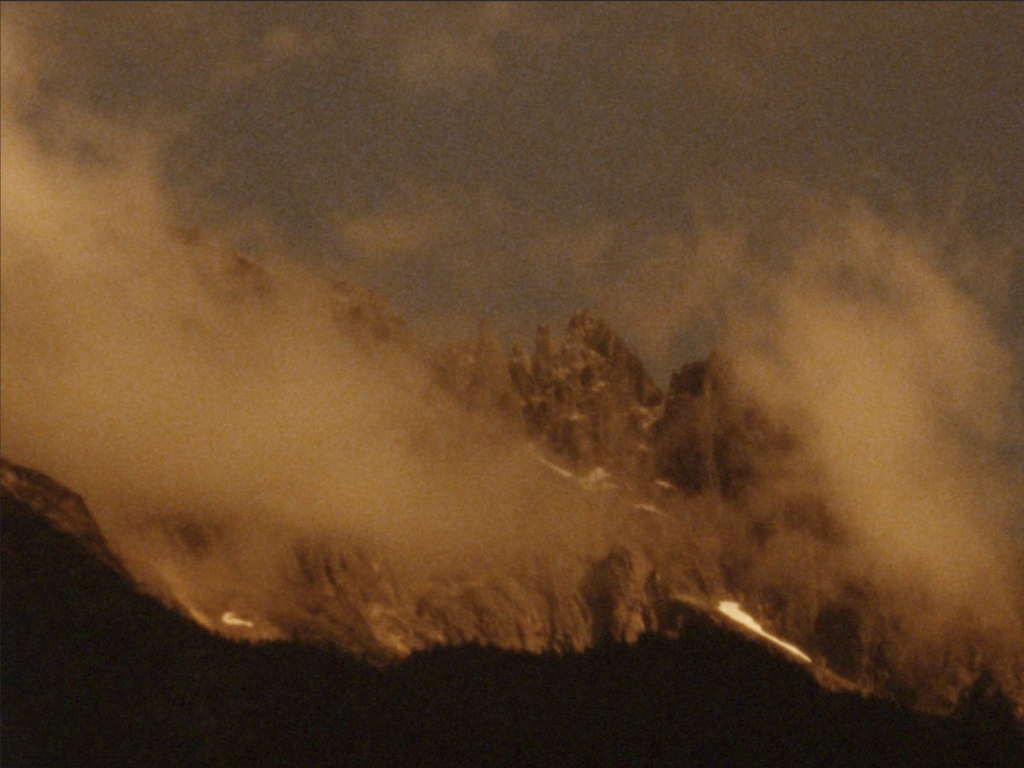
Your film Bella Sutra was inspired by, and partly named after, Allen Ginsberg’s ‘Sunflower Sutra’. What does this poem mean to you, and how did it inform the film?
Yes the title is an homage to Allen Ginsberg’s poem ‘Sunflower Sutra’, where the poem’s narrator decries a big dead blackened sunflower found at the edge of a railyard, destroyed and devastated by the careless work of modern society. He’s holding the big dead ugly thing and cries: “Poor dead flower? when did you forget you were a flower? when did you look at your skin and decide you were an impotent dirty old locomotive? the ghost of a locomotive? the specter and shade of a once powerful mad American locomotive? / You were never no locomotive, Sunflower, you were a sunflower!” I love it.
I made the film over four summers working as an inn keeper in a remote mountain village in British Columbia. I had never lived in the country before and I was really struck by how immediate life was there. How concrete and non-symbolic everything is. In the city for example we talk about ‘the environment’ like it’s some abstract elsewhere, but in the valley the environment is immediate and actually quite dangerous and there are real stakes, your relationship with the land and resources has immediate feedback. And there are so many things we take for granted living in a city: that the lights will turn on, that water will come out the tap, that there will be heat and roads to drive on and garbage will be collected. We are so disconnected from what we consume and produce, and ultimately from each other.
So the film really started as a reflection on the myth of progress. A frustration about the myth of progress. This idea that more technology and more solutions and more ethical products and more climate friendly weapons will lead to universal justice or collective liberation. And the myth of progress is this collective story, a political story, that we are moving forward, that time and history move in a straight line, and we have to continue forward on this course of growth and progress at all costs. But I don’t believe in that story, and I think it has really damaged our connection with each other and divided us from our presence on earth. The great promise of progress completely flattens the circles we are all stuck inside (personally, ancestrally, historically) and our struggles to escape those cycles.
I love the music video you directed for ‘Keys Down if You Stay’ by Cola. About halfway through, there’s a short clip from the 1915 silent movie Alice in Wonderland. What made you add this clip? How does it connect to the story of the music video?
Thank you! They are dear friends. I love Tim Darcy’s writing, he’s the voice of a generation. My interpretation of the song was someone reflecting on being at a crossroads, where you’re wondering if you’re supposed to settle down or keep chasing, but also dealing the economic impossibility of both of those dreams. So I liked that little Alice in Wonderland clip because it quickly lays out the paradox of late capitalism: so many doors to choose from, but all of them are locked. It also reminds me of a line from a T.S. Eliot poem: “We think of the key, each in his prison / Thinking of the key, each confirms a prison.”
You work extensively with found footage. What is your approach to finding and collecting material? Is it a matter of gathering a lot of content, or are you very specific in what you’re looking for?
I have a background in photography but as an artist I don’t feel tied to historical photographic or filmmaking processes or techniques. For me, image-making is an expanded practice that makes room for the ubiquity of cameras, screens, pictures, social media, cloud-based technologies, the surveillance state, etc, and all of the visual information interfaces that govern our everyday lives and the global narratives into which we project ourselves.
And I’m a big fan of filmmaker Kevin B. Lee who pioneered the ‘desktop documentary’ and this idea that filmmaking is about showing the thought process, and making that process into a narrative. And in reality the thought process involves more than just thinking original thoughts that have never been thought before, but is also a constant churn of memories, and dreams, and movies and media from childhood, and adulthood, family stories, and personal experiences of global media events, etc. So in this way I find working with the ubiquity of everyday media as raw material more interesting than making observational or highly stylized images.
My approach to gathering material is intuitive. Sometimes I am looking for something very specific, but usually I’m in a bibliodérive mode, where I let one interesting thing take me to the next. I use the Prelinger Archives often, couched within the Internet Archive, and also Youtube Creative Commons. And I use a lot of my own family home video – my family was sort of religious about video documentation so I have hours and hours of stuff. There’s a video of my baptism that made its way into Bella Sutra.
Memory is an important theme in your work, and looking at how you incorporate found footage, I’m wondering how you feel about the internet’s role in our ability to remember. Where do you draw the line between storing and maintaining something, and actually remembering it?
My first film, Cloud Gate 2, was on exactly this question. The answer is long and meandering. Storing, maintaining, and remembering – seeing, remembering, and knowing: memory is not a state, it’s a looping process.
There was a great article in Wired magazine titled ‘Amazon’s Dark Secret’, where Will Evans reports that Amazon doesn’t know where its (your) data is. As a malignantly fast-growing company, it never bothered to patch together, in a coherent, secure, and centralized way, all the arms of its business that collect and store data. The data is literally all over the place, sometimes sitting on an open network, which all employees and vendors have access to (the article was not about Amazon Web Services, the cloud computing company, but Amazon, the customer-facing retail giant).
Evans writes that, in April 2016, European Parliament passed the General Data Protection Regulation, a sweeping consumer privacy law, which went into effect in 2018. The act would limit the use of people’s personal data by companies like Amazon. It would also mean that users could request to have their data deleted. Gary Gagnon, Amazon’s vice president of information security at the time, told Evans: “I don’t know how we’re going to deal with that […] because we have no idea where our fucking data is.”
So we have this fantasy that these data centers are out there, and secure, and that all of our memories are safe and well-organized, liberating us from the task of recollection, analysis, or reflection, which can be put off to an infinitely later date, since they will always be there. James Young, the eminent historian of Holocaust studies and memorial architecture, writes in his essay ‘Against Redemption’ that there is an inverse proportion between the memorialization of the past and its contemplation of study. “It is as if once we assign monumental form to memory, we have to some degree divested ourselves of the obligation to remember.”
I think we know a little better now – in the past year or so, all anyone talks about is data centers and AI, which is great. But there is still the task at hand – to actually engage with knowledge and information and memories, and to subject ourselves to the not always fun process of thinking.
Speaking of found footage: my friend Cees Martens specializes in archiving and archival art, and I asked him to share some questions based on his own experiences and expertise:
How much liberty do you take with editing or recontextualizing found footage? Should images remain (somewhat) true to their original meaning?
The more recontextualization, the better. I like to make films and artworks that feel built from real media, media of this world, but point to something speculative. Working with found footage to do worldbuilding for a fictional narrative makes for the kind of Pyncheon encyclopedic sense of humor or tone that I aim for, where the world seems so big and absurd, but it’s just an illusion of a vast media landscape filtered through this singular imperfect perspective.
Do you experience any obstacles in dealing with copyright? How do you navigate this?
I am allergic to copyright. There’s a great book by Lewis Hyde called Common as Air: Revolution, Art, and Ownership where he lays out the foundations of copyright law and the early logic of patents, which started with an optician who invented flawless lenses. Chester Moor Hall, the 18th century inventor, intended to keep this discovery a secret so he tasked separate contractors to make the glass, not realizing that other opticians would eventually figure out what he had discovered and apply the knowledge to their own practices. This new technique for making achromatic lenses became common knowledge among instrument makers from then onward, though the trade secret was never published or shared with the public.
A second man named John Dollond came along in 1758 and ‘rediscovered’ the technique and obtained an official patent for this discovery. The opticians continued to make lenses with the patented technique though, and eventually Dollond’s son took one of them to court. The opticians argued the invalidity of the patent, because Dollond had not invented the technique, which had been in use for many years prior. However, the Dollonds actually won the suit. Lord Mansfield, Lord Chief Justice of England at the time, explained that a patent was a contract between the inventor and the public. “The commercial advantage which the inventor gains is his reward, not for having made the invention, but for having disclosed it to the public so that when the limited period of his patent has expired, the public gains free use of the new idea.” So the purpose of copyright is actually to make an idea available to public use, within a ‘fair’ timeline. So when a company like Disney incorporates the original Mickey Mouse into their present logo, because it will have fallen out of copyright, therefore re-copy-righting it, that’s against the public spirit of the law.
And copyright is also all about use. I think it was this past year, the Supreme Court ruled on the Andy Warhol Foundation vs. Goldsmith case. Long story short, Andy Warhol famously used existing photographs to make his screenprints. Some years ago, the Andy Warhol Foundation pre-emptively sued Lynn Goldsmith, the original photographer of the famous Prince screenprint. Goldsmith had no choice but to countersue, and the case ended up in the Supreme Court.
The heart of the suit was not whether or not the original artworks were fair use or not (Andy Warhol had legally licensed the photographed from Goldsmith to make the 16 artworks), but whether or not the Andy Warhol Foundation could legally re-issue or re-print the work via Condé Nast. The Court ruled no, they could not. The specific use (reprinting the image of Prince in a magazine article about Prince) was against Goldsmith’s rights, because the use was one in which either work (the original photo or the screenprint) could have been used to do the same thing: demonstrate Prince’s likeness. It’s a fascinating case to listen to, once you get your head around all the legalese, because they discuss really big questions about what art is and does.
Kevin B. Lee also has some great lectures on the issue of copyright and working with found footage. For me, working with these media fragments – revisiting them, reconstructing them, reforming them – is a way to use them to reflect on the mechanisms of manufactured consent and information control. This is anathema to big media companies, who want to protect how we interact with their products. They have a commercial stake in the images which fill our memories and dreams, and the images which structure our relationships to news and ongoing global events. They also have the resources to protect these images, and assert their ownership when they can.
There is, of course, a big difference between piracy and Fair Use. As an artist I think it’s imperative that a society use and transform its images and stories to create new art, new thought, new criticism, and to constantly reflect on the fantasies and narratives and truths it holds most dear.
Was there a specific image or fragment that sparked your desire to work with found footage?
During the pandemic I did a series of correspondences with the filmmaker Mackenzie Reid Rostad. He had just moved across the ocean and was hard to reach, so for about two years we sent each other short film letters back and forth once a month. They were just letters, sketches of ideas, and we used mostly found footage for all of it. We never intended for it to be anything, but the letters got longer and longer and eventually we both made feature-ish films at the end, mine being Cloud Gate 2, in response to his final letter ‘Kingdom, Clouds, Pirates, and Dream Sheets’.
Thank you so much for this interview! For the final question, I was curious about your work as a music photographer. Did this teach you any lessons that you still apply in your artistic practice?
Oh gosh those were the days. I also worked as a wedding photographer really early on, and my boss gave me some advice I will always remember: never cater to the madness, and always drink the champagne.
More OK Pedersen: